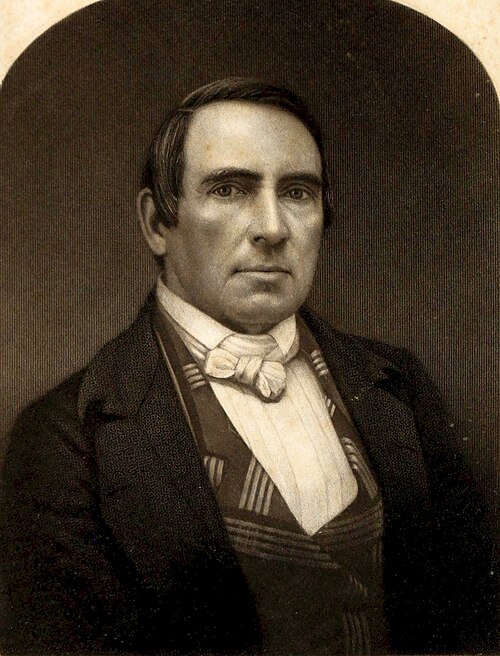
Perhaps the most serious charge brought against the Republican policy by Southern men, was that the negro was advanced to the right of suffrage, while a portion of the white population were placed under such political disabilities as…
James Blaine
The Public Record
James Gillespie Blaine was an American statesman and Republican politician who represented Maine in the United States House of Representatives from 1863 to 1876, served as Speaker of the House from 1869 to 1875, and was a United States senator from 1876 to 1881. He served twice as Secretary of State, under presidents James A. Garfield and Chester A. Arthur in 1881, and under Benjamin Harrison from 1889 to 1892. He sought the Republican presidential nomination in 1876 and 1880, and received the nomination in 1884, narrowly losing the general election to Democratic nominee Grover Cleveland. Blaine was a prominent figure in the moderate faction of the Republican Party, known as the "Half-Breeds".
gutenberg.org
Every day affords fresh proof of the disasters which have resulted to the Republican party of the South from the loss of so large a proportion of the original Union men.
But against all adverse influences, some of the truest and best of this class of Union men remained with the Republican party.
The men who had the courage to stand for the Union in time of war should not have separated from its friends in time of peace.
If these men had in all cases established as good and trustworthy governments in the South as they had been reared under in the North, they would have conferred upon all the reconstructed States a blessing which as prejudice wore away…
The government of South Carolina, under its series of Republican administrations, was of such character as brought shame upon the Republican party, exposed the negro voters to unmerited obloquy, and thus wrought for the cause of free…
They addressed them in different tone, treated them in a different manner, from that which they had been accustomed in the past to receive from the white race, and it was natural that a feeling of friendship should grow up between the…
But these men, though pecuniarily unsuccessful, quickly formed relations of kindness and friendship with the negro race.
It was this hope which nerved their arms for every encounter: it was this prospect of domination that steadily encouraged them to continue a battle which must at times have seemed desperate indeed.
They clearly saw, as their co-operating friends in the North had seen long before, that a compact vote of all the Southern States could be used as the sure foundation of a formidable, and, as they hoped, irresistible political power.
If the South had been standing alone, if it had not been receiving daily words of encouragement, of aid, and of comfort, from the North, if it had not seen that the Democratic party in Congress was fighting its battle, it might have…
But the task of enforcing obedience to laws, when obedience is not in the hearts of the people, is the most difficult undertaking ever imposed upon the governing power.
On the abstract issue thus presented the Republicans were placed somewhat at a disadvantage; and yet every white man making the complaint knew that the influence of the troops was not to deprive him of a single right, but was to prevent…
The lenity with which the triumphant Union had treated the crime of rebellion--sacrificing no man's life, stripping no man of his property, depriving no man of his personal liberty--gave the Government the right to expect order and the…
Lincoln--of the people, by the people, for the people.
These statutes were designed to protect, as far as human law can protect, the right of every man in the United States to vote, and they were enacted with special care to arrest the dangers already developing in the South against free…
His last words were: "I do not present these views now as a recommendation for a renewal of the subject of annexation, but I do refer to it to vindicate my previous action in regard to it.
My duty being done, yours begins, and I gladly hand over the whole matter to the judgment of the American people and of their representatives in Congress assembled.
Indeed, in such case the honor of the nation demands investigation.
A palpable infraction of our written charter of government by our rulers, justifies disobedience upon the part of a citizen as much as lawful orders are entitled to loyal compliance.
But as State officials can command us to no duty unknown to State laws, neither can a Federal officer claim any authority over us in matters not within his constitutional and legal control.
Shall this earnest cry for peace be stifled at the bidding of a host of fanatical and cowardly editors, aided by an army of greedy contractors and public leeches, stimulating an ignorant mob to denounce and attack us as traitors and…
If peace will restore and secure these blessings to the people of the United States, even though a number of their former associates have gone off under a new and independent organization, in the name of Heaven let us raise our voice for…
With such a sickening alternative as civil war, why should not the experiment at least be made?
Why, then, may not two American confederacies exist side by side without conflict, each emulating the other in the progress of civilization?
Politicians like James Blaine