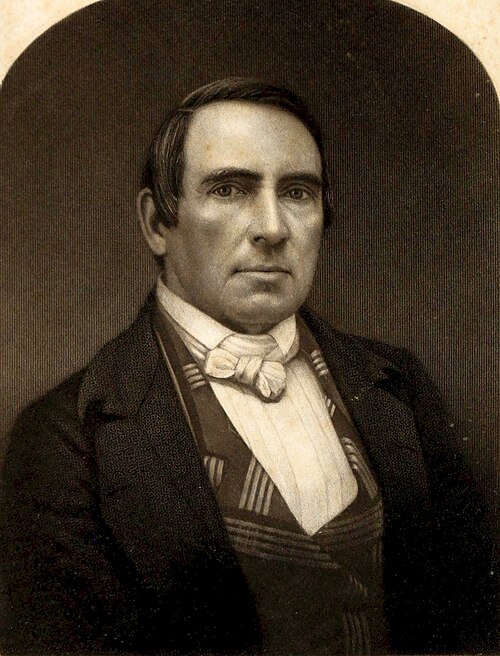
As far as my influence goes, I am determined to do all I can to prevent the reconstruction of the Union. . . .
James Blaine
The Public Record
James Gillespie Blaine was an American statesman and Republican politician who represented Maine in the United States House of Representatives from 1863 to 1876, served as Speaker of the House from 1869 to 1875, and was a United States senator from 1876 to 1881. He served twice as Secretary of State, under presidents James A. Garfield and Chester A. Arthur in 1881, and under Benjamin Harrison from 1889 to 1892. He sought the Republican presidential nomination in 1876 and 1880, and received the nomination in 1884, narrowly losing the general election to Democratic nominee Grover Cleveland. Blaine was a prominent figure in the moderate faction of the Republican Party, known as the "Half-Breeds".
gutenberg.org
Eighty years made the Republic such a power, that if she had continued as she was a few years longer she would have been the great bully of the world. . . .
America while she was united ran a race of prosperity unparalleled in the world.
I know that language will strike the heart of the peace party in this country, but it will also strike the heart of the insolent people who govern America.
With them, therefore, every interest must lead us to cultivate friendly relations, and we have seen that when the war began they at once recurred to England as their natural ally.
They furnish the raw material of our industry, and they consume the produce which we manufacture from it.
I should have affirmed then, as, undeterred by what has occurred since then, I affirm now, that secession was a right, that separation is a fact, and that reconstruction is an impossibility." Mr.
Wars have grown out of less aggravation and dispute between nations; but the Government of the United States had never anticipated such a result as possible, and felt assured that in the end Great Britain would not refuse to make the…
I alone remain, and after finishing the threescore years and ten that are the days of our years, am selected by my country to uphold its rights.
But the Government of England has been unwilling to perform the duty which had thus been agreed upon, and this refusal gives rise to the impression that England does not desire to bind itself with other nations as she has bound herself…
Conscience does make cowards of us all; and Great Britain, foreseeing the possibility of being herself engaged in a European war, was in a position to dread lest her ill intentions and her misdeed in the time of our civil struggle should…
It was not by indirection, or by stealthy blows, or by secret connivance with enemies, or by violations of international justice, that the United States would ever have sought to avenge herself on England for the wrongs she had received.
It would certainly be an unjust imputation upon the magnanimity and upon the courage of the people of the United States to represent them as waiting for an opportunity to inflict harm upon England for her conduct towards this Government in…
At a great epoch of history, not less momentous than that of the French Revolution or that of the Reformation, when civilization was fighting a last battle with slavery, England gave her influence, her material resources, to the wicked…
England has done to the United States an injury most difficult to measure.
The truth must be told, not in anger, but in sadness.
Sumner said: "If the case against England is strong, and if our claims are unprecedented in magnitude, it is only because the conduct of that power at a trying period was most unfriendly, and the injurious consequences of this conduct were…
If Englishmen had studied the Reconstruction policy instead of deriding it, they might have learned that the American Government accomplished for the South in four years what their own Government has failed to accomplish for Ireland…
The one safeguard against an evil so great was the restoration of self-government to the people who had rebelled, the broadening of the elective franchise, the abolition of caste and privilege.
A race gifted with many of the noblest qualities of humanity, strong in intellect and quick in apprehension, could not for centuries complain of grievances if they did not exist, and the grievances could not exist for centuries without…
But in Ireland, according to eminent British statesmen and historian, the suffering was from directly opposite causes.(3) Self-government of all the people was the rule established in the Southern States: subjection of all the people and…
The comparison of the Southern States under the measures of Reconstruction, with Ireland under the measures of the British Government, naturally suggested by hostile criticism in the English press, is not without its useful lessons.
It might have surprised those English critics to learn that the opponents of the Reconstruction policy at home could find nothing to say of it so denunciatory or so concentrated in bitterness as that the National Government was trying to…
No censure was too harsh, no epithet too severe to apply to the policy and to the Republican party that stood sponsor for it.
Offended by the Protective policy of the United States, the British Press now denounced the measures proposed for the Reconstruction of the South.
Politicians like James Blaine