This party controlled Congress when it levied heavy protective duties and stimulated manufacturing in American as the basis of that financial strength which proved during the civil war a marvel to the world.
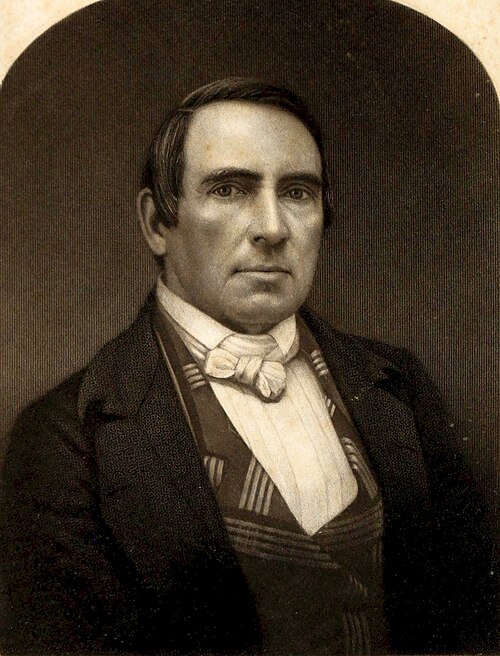
James Blaine
The Public Record
James Gillespie Blaine was an American statesman and Republican politician who represented Maine in the United States House of Representatives from 1863 to 1876, served as Speaker of the House from 1869 to 1875, and was a United States senator from 1876 to 1881. He served twice as Secretary of State, under presidents James A. Garfield and Chester A. Arthur in 1881, and under Benjamin Harrison from 1889 to 1892. He sought the Republican presidential nomination in 1876 and 1880, and received the nomination in 1884, narrowly losing the general election to Democratic nominee Grover Cleveland. Blaine was a prominent figure in the moderate faction of the Republican Party, known as the "Half-Breeds".
gutenberg.org
Especial hostility was exhibited towards the Republican party, which had conducted the Government through the war and led it to its complete triumph.
The war had closed without the execution of a single man who had borne arms against the Government, without imprisonment, without confiscation of property, without even depriving one rebel of his franchise as an elector.
In all parts of the kingdom the laboring men were on the side of the Union.
The philanthropy, the foresight, the insight of the realm were found among the humbler classes.
Russia was more than friendly to us: Germany had no interest in our destruction.
They had witnessed the marvelous growth of the United States and had concluded that, already a powerful rival, the Republic would certainly be dangerous as an enemy.
It might be that in old times judges sat on the American Bench who enjoyed world-wide reputation, but within the last two or three years the American tribunals have delivered their decisions under the pressure of fixed bayonets.
If there is a sink of political iniquity, it is at Washington.
The proclamations of President Lincoln, the decisions of Federal courts, the orders issued commanders of the Union armies, were frequently brought to the attention of Parliament, as if America were in some way accountable to the judgment…
If the Republic had been a dependency of Great Britain, like Canada or Australia, engaged in civil strife, it could not have been more steadily subjected to review, to criticism, and to the menace of discipline.
Bright, Forster, Cobden, and men of that class, spoke brave words in defense of the cause for which brave deeds were done by their kindred on this side of the Atlantic--a kindred always more eager to cherish gratitude than to nurture…
The popular conclusions, therefore, touching the conduct of England, did not spring from imagination or from prejudice; nor were they the results of illogical inference.
If the scholarship of the few is not so thorough as in certain European countries, the intelligence of the many is far beyond that of any other nation.
Perhaps the mass of the people in no other country keep so close a watch upon the progress of public events as is kept by the people of the United States.
That prejudice should stand in the way of principle, that subsidiary issues should embarrass the attainment of great ends, that personal and partisan interests should for a time override the nobler instincts of philanthropy, must be…
If they remain unaccomplished, or only partially accomplished, no discredit can attach to the great political organization which entertained lofty conceptions of human rights, and projected complete measures for their realization.
The elevation of a race, the stamping out of the last vestige of caste, the obliteration of cruel wrongs, were the objects aimed at by the Republicans.
The design was broad, patriotic, generous, and statesmanlike: the means to attain it aroused prejudices which created obstacles at every step and led to almost fatal embarrassment.
It is not the first time in history where a great and noble purpose has been weakened and thwarted by prejudices aroused against the means used to effect it.
The misfortune was, that the mistakes blinded the eyes of many candid and patriotic men to the real merit of the struggle.
This unhappy result to the South was the fruit of their unwise adherence to Andrew Johnson in a political battle which he was predestined to lose.
It is difficult to compute the loss and the suffering endured by the South from the folly of rejecting a Constitutional Amendment, which they could have had with all its benefits, and which they were compelled afterwards to accept with all…
But the truth remains, nevertheless, that in the Southern States in which no test-oaths were applied disturbance, disorder, and resistance to law were as frequent and flagrant as in those where suffrage had in some degree been qualified…
While the National Government refrained from withholding the elective franchise from men who had fought to destroy the Union, there is no doubt that disabilities and exclusions were imposed upon large classes in certain States of the South.
Politicians like James Blaine