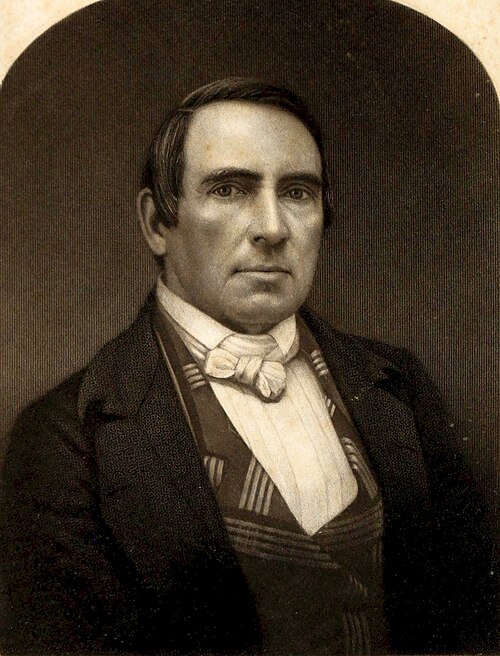
So far as chivalry, magnanimity, charity, Christian kindness, were involved, the colored men appeared at an advantage.
James Blaine
The Public Record
James Gillespie Blaine was an American statesman and Republican politician who represented Maine in the United States House of Representatives from 1863 to 1876, served as Speaker of the House from 1869 to 1875, and was a United States senator from 1876 to 1881. He served twice as Secretary of State, under presidents James A. Garfield and Chester A. Arthur in 1881, and under Benjamin Harrison from 1889 to 1892. He sought the Republican presidential nomination in 1876 and 1880, and received the nomination in 1884, narrowly losing the general election to Democratic nominee Grover Cleveland. Blaine was a prominent figure in the moderate faction of the Republican Party, known as the "Half-Breeds".
gutenberg.org
The colored representatives, who had been slaves, were willing to release their late masters from every form of disability, but the immediate friends of the masters were unwilling to extend the civil rights of the colored man.
We invoke you, gentlemen, to show the same kindly feeling towards us, a race long oppressed, and in demonstration of this humane and just feeling, I implore you, give support to the Civil-rights Bill, which we have been asking at your…
We foster no enmity now, and we desire to foster none, for their acts in the past to us or to the Government we love so well.
Nevertheless we have open and frank hearts towards those who were our former oppressors and taskmasters.
But the Democratic leaders were not willing to accept amnesty for their political friends in the South, if at the same time they must take with it the liberation of the colored man from odious personal discriminations.
Sumner, to broaden the civil rights of the colored man, to abolish discrimination against him as enforced by hotels, railroad companies, places of public amusement, and in short, in every capacity where he was rendered unequal in privilege…
Without the opportunity for elaborate investigation of each subject as it arises, he must have a mind well stored with knowledge; without time for leisurely composition, he must possess the power of writing off-hand with force and…
No test of a man's power is more severe than the demand made by a daily newspaper.
A forcible speaker, with quick perception and marked industry, he had all the requisite for success in a Parliamentary body.
I love justice and fair play, and I think I know enough of the American people to know that ninety-nine hundredths of the men who elected this administration in 1868 will disapprove this act." Mr.
We saw seeds then sown that blossomed and bore bitter fruit at Charleston in 1860.
Wrongfully applied, it is a weakness, an offense, a stumbling-block in the way of party prosperity.
Rightfully employed, the caucus in not only useful but necessary in the conduct and government of party interests.
Sumner from his place had been determined in a caucus of Republican senators, and never was the power of the caucus more wrongfully applied.
Not a word was found in the treaty, and not an inference could be drawn from it, to remove the sense of the unfriendliness of the course of Great Britain in our struggle for existence, which has so deeply and universally impressed itself…
The time and the circumstances attending the negotiation of that treaty were unfavorable to its acceptance by the people of the United States, and its provisions were wholly inadequate for the settlement of the grave wrongs that had been…
You admit that you govern that island, not as you govern England and Scotland, but as you govern your new conquests in Scinde; not by means of the respect which the people feel for the laws, but by means of bayonets, of artillery, or…
No country ever exercised a more complete control over the destinies of another than did England over those of Ireland for three-quarters of a century after the Revolution.
That the greater part of them sprang directly from the corrupt and selfish Government of England is incontestable.
These things are notorious as the proceedings of a Government which seems anxious to rival one despotic and irresponsible power of Europe in its contempt for the public opinion of mankind.
And these things were done not for military objects which would afford some excuse for them, but out of such sheer wanton malice that even the negroes looked on disgusted and aghast.
It is the duty of the British Government not to allow these infractions of maritime law to continue, which are in effect setting aside all law and practice as hitherto maintained.
I hold that it will be of the greatest importance that the reconstruction of the Union should not take place.
I say then that the Southern States have indicated their right to recognition; they hold out to us advantages such as the world has never seen before.
Politicians like James Blaine