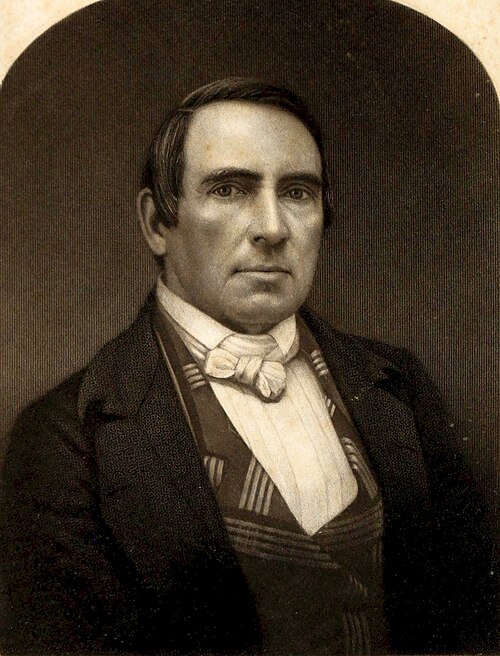
Without the graces of fancy or the arts of rhetoric, he was incomparable in direct, pungent, forceful discussion.
James Blaine
The Public Record
James Gillespie Blaine was an American statesman and Republican politician who represented Maine in the United States House of Representatives from 1863 to 1876, served as Speaker of the House from 1869 to 1875, and was a United States senator from 1876 to 1881. He served twice as Secretary of State, under presidents James A. Garfield and Chester A. Arthur in 1881, and under Benjamin Harrison from 1889 to 1892. He sought the Republican presidential nomination in 1876 and 1880, and received the nomination in 1884, narrowly losing the general election to Democratic nominee Grover Cleveland. Blaine was a prominent figure in the moderate faction of the Republican Party, known as the "Half-Breeds".
gutenberg.org
His faculty of lucid statement and compact reasoning has never been surpassed.
His command of strong, idiomatic, controversial English was unrivaled.
He was the ablest polemic this country has ever produced.
While the Democrats as a body had persistently opposed emancipation, and regarded it as a great political wrong, the party now resolved to maintain it.
Equal suffrage had been established, and the danger of repudiation which had threatened the country in 1868 had apparently passed away.
In ready debate, and in the clear and forcible presentation of political issues, he held a high place among Republican leaders.
He had always been a man of the people, and, though not shining with brilliant qualitites, had acquired influence and respect through his robust sense, his sound judgment, and his practical ability.
Even before his nomination was anticipated he was the most important factor in the revolt against the Administration, and any division (of a division) which sacrificed or endangered the chief pillar of strength seemed peculiarly fatuous…
Whatever other reasons he might have had for joining the movement, his lifelong and conspicuous championship of Protection would have made it impossible for him to sustain any demonstration against that great doctrine.
In his brief speech he said that those who had assembled in this gathering were still Republicans, and he urged in justification of their independent action that the forces in control of the party machinery had perverted it to personal and…
The renomination of General Grant was seen to be inevitable; and they were left to determine whether they would remain in the party and acquiesce in what they were unable to prevent, or whether they would try from the outside the…
The effect of the startling revelation was such that the most absolute political oligarchy ever organized in this country crumbled to dust in a moment, and the Republicans carried New York for the first time since 1866.
With this practical advance, the demand of Liberalism did not leave room for any serious difference.
The Fifteenth Amendment had irrevocably established the principle of equal suffrage.
The readiness of Congress in responding to every application for the removal of disabilities was itself a generous amnesty.
Greeley's zealous and powerful advocacy had impressed it upon many minds as the true corner-stone of Reconstruction.
He did not think they could succeed by any such manoeuvre; but he believed it would commit Democracy to a new departure, and be a long stride in the direction of loyalty and good government.
Nevertheless, the creed of the Missouri Liberals, though little applicable outside their own borders, found an echo far beyond.
To prevent them from sharing in the government while fighting to overthrow it, these allies of the Rebellion had by an amendment to the State constitution been disqualified from exercising the rights of citizenship.
Never before or since has a great party adopted as its candidate a conspicuous public man, who was not merely outside its own ranks, but who, in the thick of every political battle for a third of a century, had been one of its most…
Coals of fire were heaped on the heads of all their enemies when the colored men in Congress heartily joined in removing the disabilities of those who had before been their oppressors, and who, with deep regret be it said, have continued…
Rainey in the House--would be honorable to any race.
The colored men who took seats in both Senate and House did not appear ignorant or helpless.
The revolution in favor of human rights, promoted and directed by the Republican party, swept onward: the colored man, freed from slavery, attained the right of suffrage, and in due season was sent to Congress.
Politicians like James Blaine