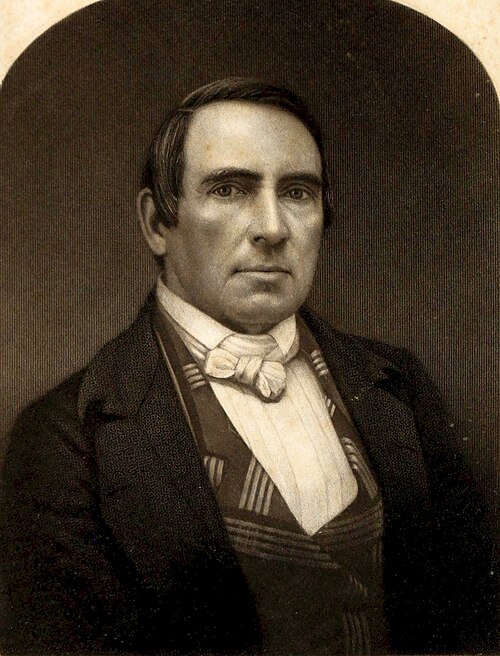
The various propositions in this Congress fairly illustrate the conflicting views on financial matters held among the people.
James Blaine
The Public Record
James Gillespie Blaine was an American statesman and Republican politician who represented Maine in the United States House of Representatives from 1863 to 1876, served as Speaker of the House from 1869 to 1875, and was a United States senator from 1876 to 1881. He served twice as Secretary of State, under presidents James A. Garfield and Chester A. Arthur in 1881, and under Benjamin Harrison from 1889 to 1892. He sought the Republican presidential nomination in 1876 and 1880, and received the nomination in 1884, narrowly losing the general election to Democratic nominee Grover Cleveland. Blaine was a prominent figure in the moderate faction of the Republican Party, known as the "Half-Breeds".
gutenberg.org
To make National banking free before compelling the banks to redeem their notes in coin, would have proved a measureless inflation, and the President wisely receded from the position assumed in his annual message.
He said in his annual message: "In view of the great actual contraction that has taken place in the currency, and the comparative contraction continuously going on, due to the increase of manufactures and all the industries, I do not…
Nor did they seem to perceive that the abrogation of this feature in the contract between the Government and the note-holders would lead to confusion and distress in commercial circles, and would violate the obligations of common honesty.
The argument was presented that if a man could not pay his overdue note he would deem it a privilege to give a new obligation to run on interest for a longer period, and the Nation ought to prove itself as honest as its citizens.
They appreciated the difference between voting for a bill of general amnesty which included Jefferson Davis without name, and voting for an amendment which named him and him only for restoration to eligibility to any office under the…
The complete pacification of the country on the basis of equal and exact justice was the leading desire of all right-minded men, and the free suffrage which this implied would give to the Republicans the opportunity for a fair trial of…
Revenge is always an ignoble motive, pardonable, if at all, when inspired by the hot blood of youth, but to be regarded as not only lamentable but pitiable in men who approach threescore and ten.
At least twice before, in the history of the Federal Government, it had been demonstrated that a President who for any cause runs counter to the views and wishes of the party that elected him is doomed to disappointment, and is fortunate…
The subsequent growth of population, the great number of new and handsome residences, the rapid and continuous rise in the value of real estate, the vastly increased number of annual visitors, have given a new life to the National Capital…
The prejudice evoked towards Governor Shepherd has in large part died away, and he is justly entitled to be regarded as one who conferred inestimable benefits upon the city of Washington.
Whatever fault may be found, whatever charges may be made, the fact remains that Governor Shepherd wrought a complete revolution in the appearance of the Capital.
Instead of the admiration which his speeches were once said to have elicited in the House, the wonder now grew that he ever could have been considered an oracle or a leader.
Stephens had maintained his original devotion to the National idea, a noble course lay before him; but when he drifted from his moorings of loyalty to the Union he surrendered the position that could have given him fame.
In joining the Rebellion he renounced a creed of Nationality in which the Democratic promoters of the Confederacy had never believed.
He could not escape from his self-imposed thraldom and he ended by following a cause whose success could bring no peace, instead of sustaining a cause whose righteousness was the assurance of victory.
There is a type of mind in the East that delights in refined fallacies, in the reconciling of apparent contradictions, in the tracing of distinction and resemblances where less subtle intellects fail to perceive their possibility.
He pleased the radical anti-slavery sentiment of New England: he did not displease the radical pro-slavery sentiment of the South.
Nothing is left you, sir, but puny sectional questions and petty strifes about slavery and fugitive-slave laws, involving no National issues.
Not only have the great men passed away, but the great issues, too, raised from our form of government and of deepest interest to its founders and their immediate descendants, have been settled, sir.
Sumner strikingly illustrates the shortsightedness and miscalculation of the Southern statesmen preceding the Rebellion.
Sumner must ever be regarded as a scholar, an orator, a philanthropist, a philosopher, a statesman whose splendid and unsullied fame will always form part of the true glory of the Nation.
He held the Republican party to a high standard,--a standard which but for his courage and determination might have been lowered at several crises in the history of the struggle for Liberty.
Profoundly conversant with all subject of legislation, he yet devoted himself absorbingly to the one issue which appealed to his judgment and his conscience.
They were not confined to party, to section, or to race.
Politicians like James Blaine