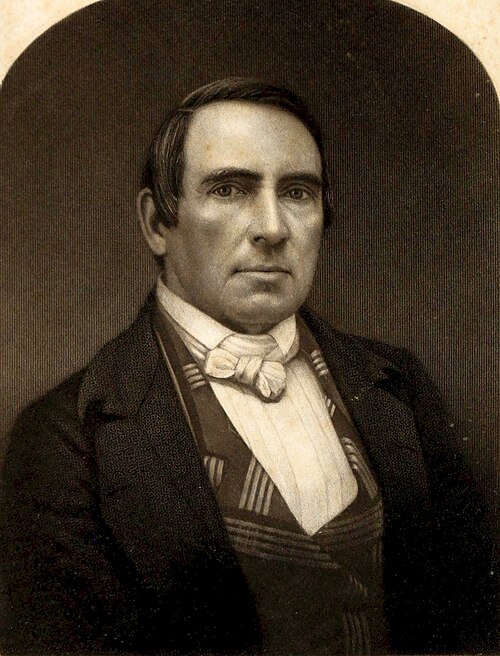
But he was gifted with strong common sense, and had that quick judgment of men which contributes so essentially to success in public life.
James Blaine
The Public Record
James Gillespie Blaine was an American statesman and Republican politician who represented Maine in the United States House of Representatives from 1863 to 1876, served as Speaker of the House from 1869 to 1875, and was a United States senator from 1876 to 1881. He served twice as Secretary of State, under presidents James A. Garfield and Chester A. Arthur in 1881, and under Benjamin Harrison from 1889 to 1892. He sought the Republican presidential nomination in 1876 and 1880, and received the nomination in 1884, narrowly losing the general election to Democratic nominee Grover Cleveland. Blaine was a prominent figure in the moderate faction of the Republican Party, known as the "Half-Breeds".
gutenberg.org
He was an accurate man and always discharged his senatorial duties with care and fidelity.
His views of financial and economical questions are often in conflict with current maxims and established precedents, but no one can listen to him without being impressed by his intellectual power.
He is a man of originality and works out his own conclusions.
His educational facilities embraced only the public schools of Cleveland, but he has by his own efforts acquired a great mass of curious and valuable information.
His mind has been enriched by the study of books and disciplined by controversy at the Bar and in the Senate.
No man ever kept more eager watch over the interests of his constituency or was more constant and indefatigable in his legislative duties.
I performed a conscientious duty without asking promotion or command, and without a revengeful feeling towards any section or individual.
I did not ask for place or position, and was entirely without influence or the acquaintance of persons of influence, but was resolved to perform my part in a struggle threatening the very existence of the Nation.
The people saw that the charges against General Hartranft were not only unfounded but malicious, and he was chosen Governor by more than 35,000 majority.
His name had been honored for so many years in every Republican household, that the desire to see and hear him was universal, and secured to him the majesty of numbers at every meeting.
He called out a larger proportion of those who intended to vote against him than any candidate had ever before succeeded in doing.
From this hour the popular current was clearly with the Republicans.
All adverse considerations were brought to bear with irresistible effect as the canvass proceeded, and his splendid services and undeniable greatness could not weigh in the scale against the political elements and personal…
The sensitive interests of business shrank from his visionary theories and his dangerous empiricism.
Those who most admired his honesty, courage, and power in the realm of his true greatness, most distrusted his fitness to hold the reins of administration.
If he was irresistible in his own appropriate sphere of moral and economic discussion, he was uncertain and unstable when he ventured beyond its limits.
If he had the strength of a giant in battle, he lacked the wisdom of the sage in council.
With his dogmatic earnestness, his extraordinary mental qualities, his moral power, and his quick sympathy with the instincts and impulses of the masses, he was in a peculiar sense the Tribune of the people.
He had on all occasions zealously defended the rights of labor; he had waged unsparing war on the evils of intemperance; he had made himself an oracle with the American farmers; and his influence was even more potent in the remote prairie…
His sympathies were equally touched by the sufferings of the famine-stricken Irish and by the wrongs of the plundered Indians.
He was keenly alive to the distinctions of right and wrong, and his philanthropy responded to every call of humanity.
In the long and arduous battle against the aggressions of Slavery, he had been sleepless and untiring in rousing and quickening the public conscience.
Great as was his intellectual power, his chief strength came from the depth and earnestness of his moral convictions.
A keen observer and an omnivorous reader, he had acquired an immense fund of varied knowledge, and he marshaled facts with singular skill and aptness.
Politicians like James Blaine