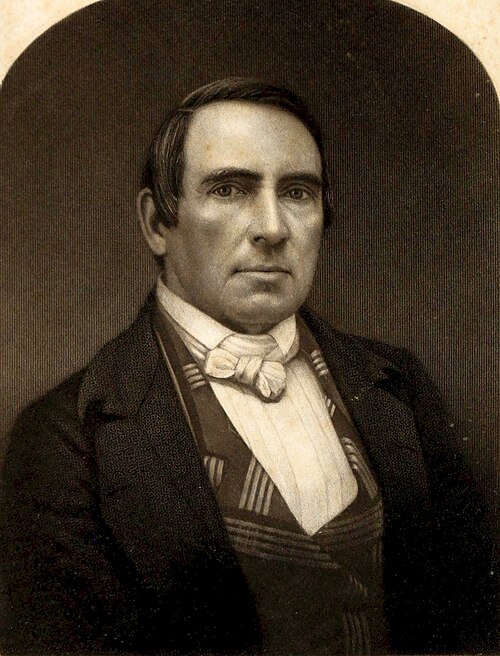
Members of the same party, supporters of the same general measures, with perfect appreciation and with profound respect each for the other, it seemed as impossible to unite them cordially, as in earlier days it was to unite Adams and…
James Blaine
The Public Record
James Gillespie Blaine was an American statesman and Republican politician who represented Maine in the United States House of Representatives from 1863 to 1876, served as Speaker of the House from 1869 to 1875, and was a United States senator from 1876 to 1881. He served twice as Secretary of State, under presidents James A. Garfield and Chester A. Arthur in 1881, and under Benjamin Harrison from 1889 to 1892. He sought the Republican presidential nomination in 1876 and 1880, and received the nomination in 1884, narrowly losing the general election to Democratic nominee Grover Cleveland. Blaine was a prominent figure in the moderate faction of the Republican Party, known as the "Half-Breeds".
gutenberg.org
How will such officials be likely to serve an Administration which they know does not trust them?
What faith can an Executive put in officials forced upon him, and those, too, whom he has suspended for reason?
Casting off all political disguises and personal pretenses, the simple truth remains that the Tenure-of-office Law was enacted lest President Johnson should remove Republican office-holders too rapidly; and it was practically repealed lest…
They thereby admitted the partisan intent that had governed the enactment, just as they admitted the partisan intent that now led to the practical repeal.
With all the plausible defenses that can be made for this contradictory course, the fact remains that the authors of the law precipitately fled from its enforcement the moment a President with whom they were in sympathy was installed in…
But it was impossible to comprehend how a candid legislator could maintain the Constitutionality and expediency of the Act, and then propose to suspend it for that specific period of General Grant's administration, when, if needed at all…
The Tenure- of-office Act was either right or wrong, expedient or inexpedient, Constitutional or unconstitutional, and it was easy to see that men could honestly differ as to its character in these respects.
There was something so baldly and shamelessly partisan in the proposition to suspend the Act just long enough to permit President Grant, without obstruction or encumbrance, to remove the Democrats whom President Johnson had appointed to…
He knew, the accused men declared, as much about their character when their names were before the Senate, as he knew now when he sought, behind the protection of his privilege, to brand them with infamy.
The Republican members of both branches quickly perceived that tying the hands of a hostile President like Andrew Johnson afforded more satisfaction than the same process applied to a friendly President like General Grant.
But General Grant was resolved that neither he nor the members of his Cabinet would go through the disagreeable and undignified process of filing reasons for suspending an officer, when in fact no reason existed aside from obnoxious…
But his presence, while demonstrating the extent to which the assertion of equal rights had been carried, served to increase and stimulate the Southern resistance to the whole system of Republican reconstruction.
The Fifteenth Article of Amendment to the Constitution, now pending and about to be adopted, would confirm the colored man's elective franchise and add the right of holding office.
If any considerable number of them had been gifted in a high degree as orators, they would have had great advantages among a people who rate mere eloquence above its true value.
But their misfortune was that they had assumed a responsibility which could be successfully discharged only by men of extraordinary endowments.
No man wrought so effectively in exposing the condemnation of public opinion the evil work of the Ku-Klux organizations in the South.
He spoke earnestly against the use of the National power to hold these States to their duty as members of a common government, and expressed the belief that it would be better to have two republics, than to have one strong enough to…
This threat was so serious and so lawless that it should have received more attention than was bestowed upon it when first put forth.
His language was, therefore, a distinct threat to override the Constitution in order to strip the negro of the political power which the Constitution had conferred upon him.
Bayard united with other Democrats in this declaration the right of the negro to vote had already been protected by an Amendment to the Constitution.
Bayard joined with the minority of the committee in the distinct avowal that negro suffrage would practically cease when the Republican party should be defeated.
In truth he has gone as far as the most rancorous rebel leader of the South, touching the Reconstruction laws and the suffrage of the negro.
When he took his seat in the Twenty-ninth Congress the issue in regard to the extension of slavery in the Territories was beginning to enlist public interest.
The large body of American citizens of German birth are intensely attached to their new home, and seek the most complete identification of themselves and their descendants with the development and destiny of the Great Republic.
Politicians like James Blaine