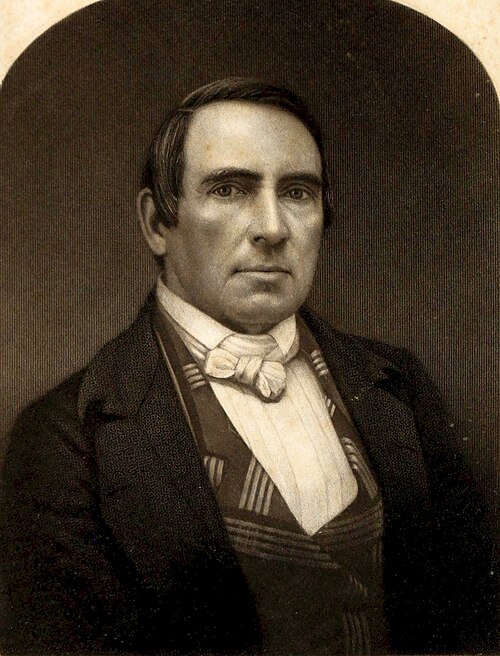
He is an orator,--affluent in diction, graceful in manner, with all the rare and rich gifts which attract and enchain an audience.
James Blaine
The Public Record
James Gillespie Blaine was an American statesman and Republican politician who represented Maine in the United States House of Representatives from 1863 to 1876, served as Speaker of the House from 1869 to 1875, and was a United States senator from 1876 to 1881. He served twice as Secretary of State, under presidents James A. Garfield and Chester A. Arthur in 1881, and under Benjamin Harrison from 1889 to 1892. He sought the Republican presidential nomination in 1876 and 1880, and received the nomination in 1884, narrowly losing the general election to Democratic nominee Grover Cleveland. Blaine was a prominent figure in the moderate faction of the Republican Party, known as the "Half-Breeds".
gutenberg.org
It is needed as a remedy for malfeasance in office and to prevent the continuance thereof.
He said: "In order to sustain Impeachment under our Constitution I do not hold that it is necessary to prove a crime as an indictable offense, or any act malum in se.
We are therefore free in every sense to submit to the guidance alone of reason and duty.
If by fortune, as was his hope, he should receive a sufficient number of votes in the North to make a majority, then, with the support of the Army which he had corrupted, he had determined to be inaugurated President of the United States…
He knew that if he could corrupt the leaders of the Army, if he could bend these men to his will, these ten States were in his control, and that he could send to the Democratic Convention, to be holden on the 4th of July next, men who…
And, sir, I shall for one be grievously disappointed if, within ten days from this time, honest old Ben Wade (now President of the Senate) is not President of the United States.
There have been grave doubts with regard to the policy and the right of impeaching the President upon the facts as presented heretofore, but at the present hour I know of no man who loves his country more than party who will not pronounce…
You establish a precedent which all future parties in all time to come will look to.
You settle that hereafter a party having a sufficient majority in the House and the Senate can depose the President of the United States.
In defiance of the letter and spirit of the Tenure-of-office Act he had removed the Secretary of War from office.
A flagrant offense against the Constitution and the laws had, in the judgment of a majority of its members, been committed by the President.
It presented a condition of affairs for which there was no precedent, and the wisest could not foresee to what end it might lead.
The history of every preceding Administration and of every subsequent Administration of the Federal Government proves that the Senate was in the wrong.
And if I supposed that either of these gentlemen was so wanting in manhood, in honor, as to hold his place after the politest intimation from the President of the United States that his services were no longer needed, I certainly, as a…
It has seemed to me that if we revolutionize the practice of the Government in all other respects, we might let this power remain in the hands of the President of the United States; that we should not strip him of this power, which is one…
But outside of this quarrel of partisans the great mass of quiet citizens and more especially the manufacturing, commercial, and financial communities, were profoundly grateful that the country was not, as they now believed, to be…
The advocates of Impeachment were denounced as rash, hot-headed, sensational, bent on leading the party into an indefensible position; while its opponents were spoken of as faint-hearted, as truckling to the Administration, as afraid to…
It is difficult to understand the intensity of conviction which had taken possession of certain minds on this subject--difficult to understand why the same causes and the same reasons which operated so powerfully on certain Republicans in…
There is no doubt that many earnest Republicans were so impressed by the perverse course of President Johnson that they came to believe him capable of any atrocious act.
From the time of the acquisition of Louisiana until the purchase of Alaska, the additions of territory to the United States had all been in the interest of slavery.
To this source of wealth on land that of the water must be added, in the seal and food fish which are found in immeasurable quantities along the coast of the mainland and the islands.
In the world's rapid and wasteful consumption of wood, the forests of Alaska will prove not merely a substantial resource for the interests of the future, but a treasure-house in point of pecuniary value.
To give it effect the action of Congress is necessary, and in this action the representatives and senators act on their own judgment and responsibility and not on the judgment and responsibility of the treaty-making power.
A treaty which stipulates for the payment of money undertakes to do that which the treaty-making power cannot do; therefore the treaty is not the supreme law of the land.
Politicians like James Blaine