If the National credit was to be maintained these sixteen hundred millions of floating obligations must be promptly placed on a basis that would give time to the Government to provide means for their ultimate redemption.
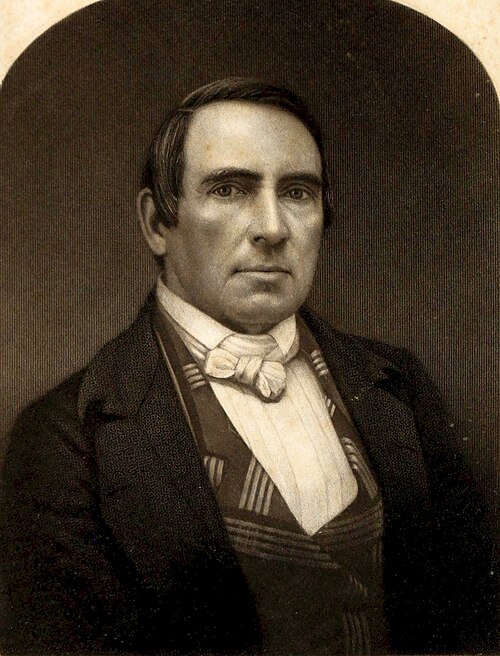
James Blaine
The Public Record
James Gillespie Blaine was an American statesman and Republican politician who represented Maine in the United States House of Representatives from 1863 to 1876, served as Speaker of the House from 1869 to 1875, and was a United States senator from 1876 to 1881. He served twice as Secretary of State, under presidents James A. Garfield and Chester A. Arthur in 1881, and under Benjamin Harrison from 1889 to 1892. He sought the Republican presidential nomination in 1876 and 1880, and received the nomination in 1884, narrowly losing the general election to Democratic nominee Grover Cleveland. Blaine was a prominent figure in the moderate faction of the Republican Party, known as the "Half-Breeds".
gutenberg.org
The measures adopted at the close of the Thirty-eighth Congress, after four years of desperate struggle and on the very eve on National victory, showed as great readiness to make sacrifices, as little disposition to count the cost of…
In spite however of all suggested fears and doubts, a feeling of confidence pervaded the country, and was fully shared by Congress, that the power which had saved the Union could re-establish its credit without panic and without dangerous…
But in this country the purpose was early formed, not simply to provide for the interest upon the debt incurred in the war for the Union, but to begin its payment at once, and to arrange for its rapid liquidation.
When Congress first met after the close of hostilities (December, 1865), it was as a ship sailing into dangerous and unknown seas without chart of possible channels.
He would not permit the menace of military organizations, and expressly refused to allow any parading of armed men, except of United-States troops.
He insisted on fair dealing, and suppressed all interference with voters by violence or threats of violence on the part of the late rebels.
The right of trial by jury, the habeas corpus, the liberty of the press, the freedom of speech, the natural rights of persons, and the rights of property, must be preserved.
It is a tribute of honor to the Supreme Court that through all the mutations of its existence only a single Justice has proved unfaithful to the Union of the States; and prior to the war three-fifths of all the Justices were appointed from…
On the Bench, he falls short of the full measure of his exalted duty if by any way or any expression he discloses his sympathy with one political party or his prejudice against another.
Off the Bench, his right to political opinions is no more to be questioned than that of any other citizen.
They stood stubbornly, solidly, without reason, without justification, against a great enlargement of popular rights.
But the action of the Northern Democrats cannot be accounted for and cannot be excused.
To Congress is committed the authority to enforce every provision of the Fourteenth Amendment, and the humblest man who is denied the equal protection of the laws of a State can have his wrongs redressed before the Supreme Judiciary of the…
It increases the power of the Republic to do equal and exact justice to all its citizens, and curtails the power of the States to shelter the wrong-doer or to authorize crime by a statute.
It abolishes caste and enlarges the scope of human freedom.
The provision is comprehensive and absolute, and sweeps away at once every form of oppression and every denial of justice.
Nor can the Catholic, or the Protestant, or the Jew be placed under ban or subjected to any deprivation of personal or religious right.
The abuses which were formerly heaped on the citizens of one State by the legislative and judicial authority of another State were rendered thenceforth impossible.
Instead of a man being a citizen of the United States because he was a citizen of one of the States, he was now made a citizen of any State in which he might choose to reside, because he was antecedently a citizen of the United States.
Its opening section settled all conflicts and contradiction on this question by a comprehensive declaration which defined National citizenship and gave to it precedence of the citizenship of a State.
But this rank injustice and this hurtful inequality were removed by the Fourteenth Amendment.
In the rapid increase of the negro race the offensive discrimination against the North would be continually enlarging in its proportions.
This ratio of influence went into the Electoral College, and gave to the white men of South Carolina, Mississippi and Louisiana double the power of that enjoyed by white men in New York, Illinois and California.
In Congressional districts where the colored race constituted one-half of the total population (and in many instances the proportion was even larger), the vote of one white man offset the vote of two in a Northern district where suffrage…
Politicians like James Blaine