Already fifteen hundred Union men have been massacred in cold blood (more than the entire population of some of the towns in my district), whose only crime has been loyalty to your flag. . . .
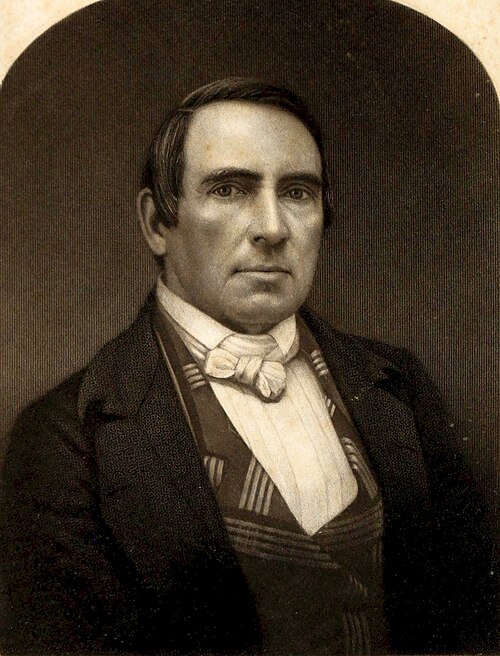
James Blaine
The Public Record
James Gillespie Blaine was an American statesman and Republican politician who represented Maine in the United States House of Representatives from 1863 to 1876, served as Speaker of the House from 1869 to 1875, and was a United States senator from 1876 to 1881. He served twice as Secretary of State, under presidents James A. Garfield and Chester A. Arthur in 1881, and under Benjamin Harrison from 1889 to 1892. He sought the Republican presidential nomination in 1876 and 1880, and received the nomination in 1884, narrowly losing the general election to Democratic nominee Grover Cleveland. Blaine was a prominent figure in the moderate faction of the Republican Party, known as the "Half-Breeds".
gutenberg.org
The American people demand that we shall do something, and quickly.
It met the spirit of defiance on the part of the South with an answer so decisive, that the misguided people of that section were rapidly undeceived as to their power to command the situation, even with all the aid the President could…
I believe on the contrary, that they will eventually uphold all those who have patriotism and courage to stand by the Constitution and who place their confidence in the people.
It was naturally inferred and was subsequently proved, that the Southern States would not have dared to take this hostile attitude except with the encouragement and the unqualified support of the President.
They came spontaneously, as if by inspiration, from the mass of the people, and were based on that instinctive sense of justice which the multitude rarely fails to exhibit.
The response throughout the North, in the mouths of the loyal people, was in effect: "If these rebel States are not willing now to resume representation on the terms offered, let them stay out until their anger ceases and their reason…
We decline, in brief, to assent to any of the conditions or provisions of the proposed amendment to the Constitution, and we deny your right to amend it without our consent.
We decline to pledge ourselves that the debts incurred in aid of the Rebellion shall not in the future be paid by our States.
We decline to guarantee the sacredness of pensions to soldiers disabled in the War for the Union.
We decline to give any guarantee for the validity of the public debt.
We demand that without giving negroes the right to vote, they shall yet be counted in the basis of representation, thus increasing our political power when we re-enter Congress beyond that which we enjoyed before we rebelled, and beyond…
We will not consent that the freedom of the negro shall be made secure by endowing him with citizenship.
We will not consent to your Fourteenth Amendment to the Constitution.
It was as if they had said in so many words: "We are entitled to representation in Congress, and we propose to resume it on our own terms; and therefore we reject your conditions with scorn.
This course on the part of the Southern States was simply a declaration of defiance to Congress.
The ten Confederate States which stood knocking at the door of Congress for the right of representation, were fully aware, as was well stated by a leading Republican, that the key to unlock the door had been placed in their own hands.
The seats of fifty members in the House and twenty members in the Senate are yet vacant, not by their own consent, nor by a failure of election, but by the refusal of Congress to accept their credentials.
Ten States, more than one-fourth of the whole number, remain without representation.
It came from the people rather than from the political leaders.
There was an unmistakable manifestation throughout the whole political canvass of 1866, by the more advanced section of the Republican party, in favor of demanding impartial suffrage as the basis of reconstruction in the South.
If the contest had ended in a victory for the Democrats the history of the subsequent years would, in all probability, have been radically different.
The defeat was so decisive that if the President had been wise he would have sought a return of friendly relations with the party which had elected him, or at least some form of compromise which would have averted constant collision, with…
The unhappy indication of the whole result was that President Johnson's policy had inspired the South with a determination not to submit to the legitimate results of the war, but to make a new fight and, if possible, regain at the…
When at last a test was reached and the people had an opportunity to speak the Administration was overwhelmingly defeated.
Politicians like James Blaine