The motive for thus separating was to leave the Southern loyalists entirely untrammeled in their proceedings, in order that their voice might have greater weight in the country than if it were apparently directed by a large majority of…
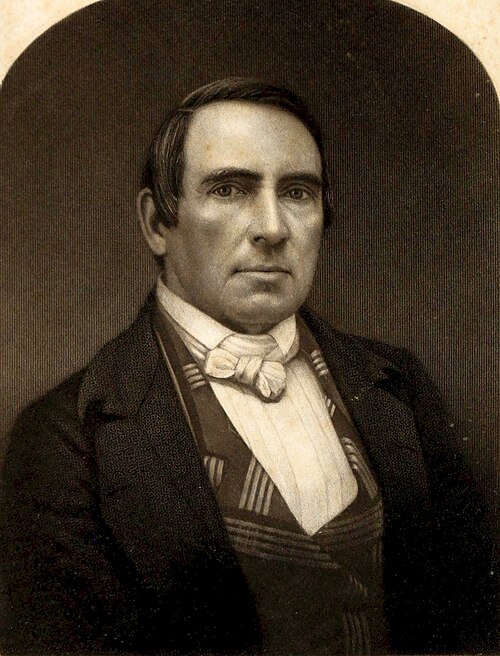
James Blaine
The Public Record
James Gillespie Blaine was an American statesman and Republican politician who represented Maine in the United States House of Representatives from 1863 to 1876, served as Speaker of the House from 1869 to 1875, and was a United States senator from 1876 to 1881. He served twice as Secretary of State, under presidents James A. Garfield and Chester A. Arthur in 1881, and under Benjamin Harrison from 1889 to 1892. He sought the Republican presidential nomination in 1876 and 1880, and received the nomination in 1884, narrowly losing the general election to Democratic nominee Grover Cleveland. Blaine was a prominent figure in the moderate faction of the Republican Party, known as the "Half-Breeds".
gutenberg.org
It was intended to be, and was, a representative body of true Union men, of the men who had borne persecution for Loyalty's sake, of the men who, having aided in achieving great victory, were resolved that it should not fail to bear its…
They believed that the Congress of the United States would be guilty of a great wrong if it should unconditionally surrender its power to the men who demanded admission to peaceful control of the National only because they had failed to…
They did not require any refinement of argument to convince them that men who attempt to destroy a Government should not be permitted at once to share in its administration.
This assertion of the right of the Southern States to take part at once and peremptorily in the legislation of a country they had sought to ruin, was not conceded by the people of the loyal States.
In every form in which the argument could be presented, they disputed the right of power to attach any condition whatever to the re-admission of the rebel States to a free participation in the proceedings of Congress.
The convention challenged the right of Congress to deny representation to a State, for a single day after the war was ended and submission to the National authority had been proclaimed throughout the area of the Rebellion.
In the resolutions, in the address, and in all the speeches, the one refrain was the right of every State to representation in Congress.
He saw his duty, and promptly retired from a position which he felt that he could not hold with personal consistency and honor.
All persons born or naturalized in the United States, and subject to the jurisdiction thereof, are citizens of the United States and of the State wherein they reside.
Seldom in the history of the country has a weightier question been submitted to popular arbitrament; seldom has a popular decision been evoked which was destined to exercise so far-reaching an influence upon the progress of the nation…
It was evident from that moment that no one of the Confederate States would ever again be admitted, so long as the Republican party held power in the country, except by giving their assent to the incorporation of the Fourteenth Amendment…
The language of the amendment, the very careful form in which the tense was expressed, appeared to leave no other meaning possible, and the intention of legislators was definitively established by the negative votes already referred to.
The effect of this vote unmistakably settled, in the judgment of the law-making power of the Government, that the operation of the Fourteenth Amendment would not in the least degree be affected by the President's pardon.
It seems to me that where a person has taken a solemn oath to support the Constitution of the United States, there is a fair implication that he cannot afterwards commit an act which in its effect would destroy the Constitution of the…
I admit that a pardon removes all liability to punishment for a crime committed, but there is a vast difference between punishment for a crime and withholding a privilege.
In my judgment we do not sufficiently protect the loyal men in the rebel States from the vindictive persecutions of their rebel neighbors.
But I never dreamed that all punishment could be dispensed with in human society.
I have long since wished that capital punishment were abolished.
The sequitur is obvious,--the case is proved because, inasmuch as the Constitution provides that there shall be no aristocracy, no oligarchy, no monopoly, therefore Congress has resolved that there shall not be any thing of the kind.
By the same title that we claim liberty do we claim equality also. . . .
God has so linked the National welfare with National duty that you cannot deny these rights without peril to the Republic.
For some time we have been carefully expunging from the statute-books the word 'white,' and now it is proposed to insert into the Constitution itself a distinction of color.
It was wrong to admit into the Constitution the idea than man could hold property in man.
Well-authenticated instances exist in every slave State, where men of Caucasian descent, of Anglo-Saxon blood, have been confined in slavery and they and their posterity held as slaves, so that not only were free blacks found everywhere…
Politicians like James Blaine