It had created a deep and wide-spread excitement in the country, and came very near precipitating hostilities with Great Britain.
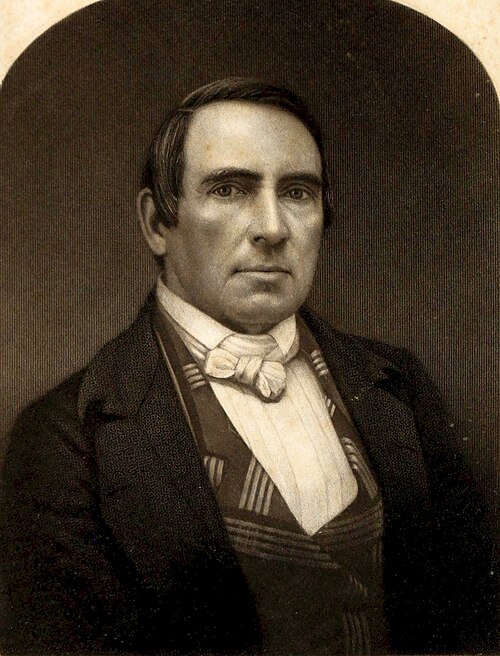
James Blaine
The Public Record
James Gillespie Blaine was an American statesman and Republican politician who represented Maine in the United States House of Representatives from 1863 to 1876, served as Speaker of the House from 1869 to 1875, and was a United States senator from 1876 to 1881. He served twice as Secretary of State, under presidents James A. Garfield and Chester A. Arthur in 1881, and under Benjamin Harrison from 1889 to 1892. He sought the Republican presidential nomination in 1876 and 1880, and received the nomination in 1884, narrowly losing the general election to Democratic nominee Grover Cleveland. Blaine was a prominent figure in the moderate faction of the Republican Party, known as the "Half-Breeds".
gutenberg.org
Fifty-four forty or fight" had been a good cry for the political campaign; but, when the fight was to be with Great Britain, the issue became too serious to be settled by such international law as is dispensed on the stump.
The directors of the administration saw therefore more and more clearly that, if a war with Mexico were impeding, it would be sheer madness to open a quarrel with Great Britain, and force her into an alliance against us.
The decisive step, in the policy to which the administration was committed, was to give formal notice to Great Britain that the joint occupancy of the Oregon country under the treaty of 1827 must cease.
Dangerous as it was to the new administration to confront the issue, it would have been still more dangerous to attempt to avoid it.
The Democrats in their eagerness had left no road for honorable retreat, and had cut themselves off from the resources and convenient postponements of diplomacy.
Fifty-four forty or fight" became a Democratic watchword; and the Whigs who attempted to argue against the extravagance or inexpediency of the claim continually lost ground, and were branded as cowards who were awed into silence by the…
The patriotic spirit of the country was appealed to, and to a considerable extent aroused and inflamed by the ardent and energetic declaration of our title to the whole of Oregon.
The war, undertaken for the extension of slavery, led in the end to its destruction.
Had the Southern statesmen foreseen the immense wealth, population, and value of this imperial domain in the five great States and four Territories into which it is to-day divided, they would have abandoned the struggle for equality.
Looking into the future, the Southern men took alarm lest the equality of their section should be lost in the Senate, and their long control of the Federal Government ended.
With one-half of the Senate under the control of the slave-holding States, and with the Constitution declaring that no amendment to it should ever destroy the equality of the States in the Senate, the Southern leaders occupied a commanding…
Much more can one absolute half of a legislative assembly, compactly united, succeed in dividing and controlling the other half, which has no class interest to consolidate it, and no tyrannical public opinion behind it, decreeing political…
A strong minority, so disciplined that it cannot be divided, will, in the hands of competent leaders, annoy, distract, and often defeat, the majority of a parliamentary body.
A tie-vote cannot carry measures, but it can always defeat them; and any combination of votes that possesses the negative power will in the end, if it can be firmly held, direct and control the positive action of the body to which it…
It was an accepted fact that the class interest of slavery, by holding a tie in the Senate, could defeat any measure or any nomination to which its leaders might be opposed; and thus, banded together by an absolutely cohesive political…
The policy of maintaining an equality of slave States with free States was to be pursued, as it had already been from the foundation of the government, with unceasing vigilance and untiring energy.
The Free-soil sentiment which so largely pervaded the ranks of the Northern Democracy had no representative in the cabinet, and a man of pronounced anti-slavery views was as severely proscribed in Washington as a Roundhead was in London…
This being the condition of the two great parties which divided the country, it was evident that the acquisition of territory from Mexico must lead to an agitation of the slavery question, of which no man could measure the extent, or…
A large number of distinguished Democrats in the North also entertained the strongest anti-slavery convictions, and were determined, at the risk of separating from their party associates, to resist the spread of slavery into free territory.
But Texas had passed definitely and finally beyond the control of Mexico, and the practical issue was, whether we should incorporate her in the Union or leave her to drift in uncertain currents--possibly to form European alliances which we…
Polk was an unquestionable verdict from the people in favor of the annexation of Texas.
For the one without qualification, against the other without reservation, was the rule of division from the northernmost township of New England to the mouths of the Mississippi.
There was not in the whole country, during the long period of their rivalry, a single citizen of intelligence who was indifferent to Clay or to Jackson.
Webster was stronger in logic and in speech; Calhoun more acute, refined, and philosophic; Van Buren better skilled in combining and directing political forces; but to no one of these was given the sublime attribute of leadership, the…
Politicians like James Blaine