His mind was intent on harmonizing the serious differences between North and South, and he believed the President's plan would fall short and fail.
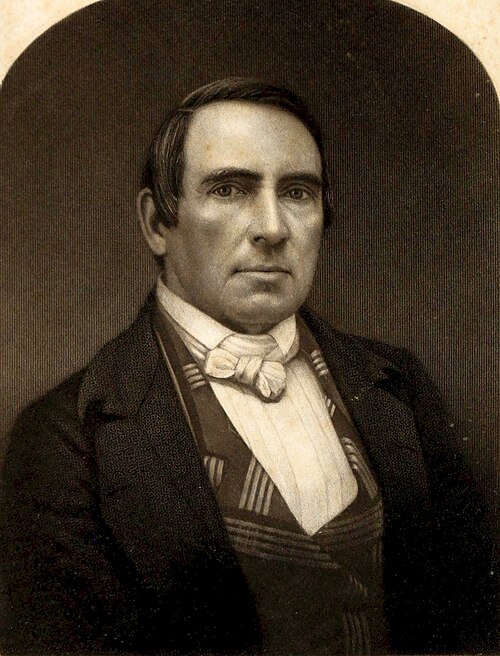
James Blaine
The Public Record
James Gillespie Blaine was an American statesman and Republican politician who represented Maine in the United States House of Representatives from 1863 to 1876, served as Speaker of the House from 1869 to 1875, and was a United States senator from 1876 to 1881. He served twice as Secretary of State, under presidents James A. Garfield and Chester A. Arthur in 1881, and under Benjamin Harrison from 1889 to 1892. He sought the Republican presidential nomination in 1876 and 1880, and received the nomination in 1884, narrowly losing the general election to Democratic nominee Grover Cleveland. Blaine was a prominent figure in the moderate faction of the Republican Party, known as the "Half-Breeds".
gutenberg.org
The events of the preceding year were too fresh, the wounds too deep, to be readily forgotten or quickly healed.
Their successors in public responsibility, if not their equals in public regard and confidence, were already upon the stage preparing for, and destined to act in, the bloodiest and most memorable of civil struggles.
At no time before or since in the history of the Senate has its membership been so illustrious, its weight of character and ability so great.
The President recommended that California, with her constitution, already known to be anti-slavery, be promptly admitted to the Union.
The message of the President was immediately transmitted, and proved a tower of strength to the friends of the Union, and a heavy blow to the secession element, which was rampant in Congress.
He stood on the dividing-line between the mere politician and the statesman,-- perfect in the arts of the one, possessing largely the comprehensive power of the other.
He had extraordinary tact in commending himself to the favor and confidence of the people.
But he was able, industrious, and, in political management, clever beyond any man who has thus far appeared in American politics.
In point of mere intellectual force, he must rank below the really eminent men with whom he was so long associated in public life.
In the pithy phrase of John Van Buren, they had exposed him to the country as the candidate "powerful for mischief, powerless for good.
He thoroughly distrusted Cass, --not in point of integrity, but of discretion and sound judgment as a statesman.
He had disregarded a personal and political friendship of thirty years' duration, and had sundered ties which life was too short to re- unite.
On a question of bread, the half-loaf is preferable to starvation, but when political honor and deep personal feeling are involved, so material an adjustment is not practicable.
The cause might seem inadequate, but the effect was undeniable.
He was placed before the people on his record as a soldier, unhampered by the political declarations which make up the modern platform.
The Democratic party had precipitated the war, had organized the military force that prosecuted it, had controlled its immense patronage, and had brought it to a victorious conclusion, yet had gained no political strength in the country.
No American President would dare to submit such a treaty to the Senate.
To throw these States away by an anti-slavery crusade was to accept inevitable defeat, and disband the Whig party.
It was in large degree the moral courage of his position which first fixed the attention of the country and then attracted its admiration.
His service in the House gave him a name as enduring as the Republic whose history he adorned.
The amplitude of his knowledge, his industry, his unflagging zeal, his biting sarcasm, his power to sting and destroy without himself showing passion, made a combination of qualities as rare as it was formidable.
His warfare against those who would suppress free speech, his heroic contest in favor of the right of the humblest to petition for redress of grievances, are among the memorable events in the parliamentary history of the United States.
He entered the House of Representatives in 1831, and for the remainder of his life, a period of seventeen years, he was the one grand figure in that assembly.
To those he added a high standard of morality, and a love and endurance of labor possessed by few.
Politicians like James Blaine