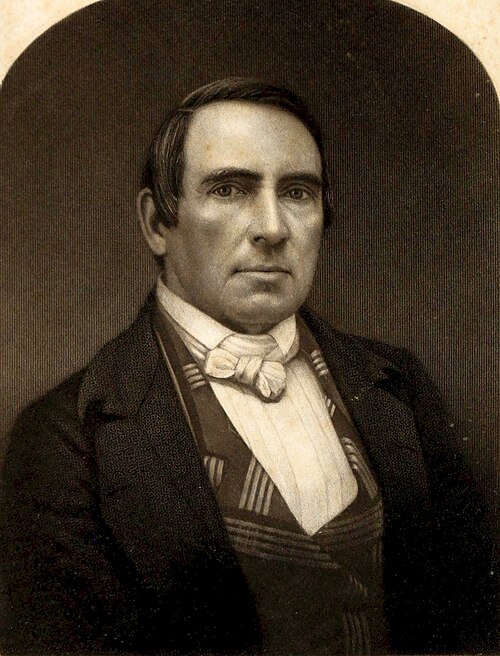
The great body of thinking men in the North saw that the real contest impending was against slavery and not against naturalization laws and ecclesiastical dogmas.
James Blaine
The Public Record
James Gillespie Blaine was an American statesman and Republican politician who represented Maine in the United States House of Representatives from 1863 to 1876, served as Speaker of the House from 1869 to 1875, and was a United States senator from 1876 to 1881. He served twice as Secretary of State, under presidents James A. Garfield and Chester A. Arthur in 1881, and under Benjamin Harrison from 1889 to 1892. He sought the Republican presidential nomination in 1876 and 1880, and received the nomination in 1884, narrowly losing the general election to Democratic nominee Grover Cleveland. Blaine was a prominent figure in the moderate faction of the Republican Party, known as the "Half-Breeds".
gutenberg.org
The most striking result in the political field, produced by the repeal of the Missouri Compromise, was the utter destruction of the Whig party.
He placed the value of the Union above the value of slavery, and was a relentless foe to all who plotted against the integrity of the government.
More than forty Democratic representatives from the North flatly defied party discipline and voted against the repeal.
But now a Northern senator of remarkable ability, a party leader, a candidate for the Presidency, had reported the measure, and made it a test of Democratic faith, of administration fealty.
Hence the resort to the doctrine of non-intervention under which the South should get all they wished by having the right to carry their slaves into the territory, and the North could be conciliated by the presentation of another final…
Clay had been honorably identified with the pacific work of 1820, and throughout his life believed that it had been effectual in allaying the strife which in his judgment had endangered the Union.
The bill had fully recognized the binding force of the Missouri Compromise, and if it had passed, there could have been no pretense for the introduction of slavery in the territory of Nebraska.
The tide of emigration which had filled Iowa and Wisconsin, and which by the gold excitement of California had for a time been drawn to the Pacific slope, now set again more strongly then ever to the Mississippi valley, demanding and…
By the Missouri Compromise every square mile of this domain had been honorably devoted to freedom.
To move was indeed hazardous, but it gave them a chance to re-establish their equality in the administration of the government, and for this they determined to risk every thing.
To stand still was certain though slow destruction to slavery.
Seeing slavery thus hemmed in on all sides by nature as well as law, and sincerely believing that in such a position its final extinction was but a question of time, the Southern leaders determined to break the bonds that bound them.
Texas was as large as France, and from the Sabine to the Rio Grande there was not a cotton-planter or a cattle- herder who did not have this fact before his eyes to inflame his pride and guide his vote against parting with a single square…
The break now was ominous; the claim of equality had been disregarded; the superstition which upheld it was dispelled, and the defenders of slavery could see only a long procession of free States marching from the North-West to re-enforce…
In the battle between free institutions and slave institutions, California represented a strong flank movement threatening destruction to slavery.
There was no national disquietude on the vexed question of slavery when Franklin Pierce was installed as President.
But though these peculiarly odious transactions exerted a deeper influence on public opinion than the Democratic leaders imagined, they were local and apparently under control.
Thoughtful men, wise in the administration of government, skilled in the management of parties, would have found in these figures food for reflection and abundant reason for hoisting cautionary signals along the shores of the political sea.
Other men have excelled him in specific powers, but in the rare combination of qualities which constitute at once the matchless leader of party and the statesman of consummate ability and inexhaustible resource, he has never been surpassed…
Condemning the worthless system of paper money imposed upon the people by irresponsible State banks, he stood firmly for a national currency, and he foreshadowed if he did not reach the paper money which is based to-day on the credit and…
Discarding theories and overthrowing the dogma of strict construction, he committed the General Government irrevocably to internal improvements.
He advanced the doctrine of protection to the stately dignity of the American system.
Clay's speeches swayed listening senates and moved multitudes, but reading them is a disappointment.
The Whigs had been beaten almost as badly when Clay ran against Jackson in 1832, and yet the party had rallied to four earnest contests and to two signal victories.
Politicians like James Blaine