It was received throughout the North with scorn and indignation.
James Blaine
The Public Record
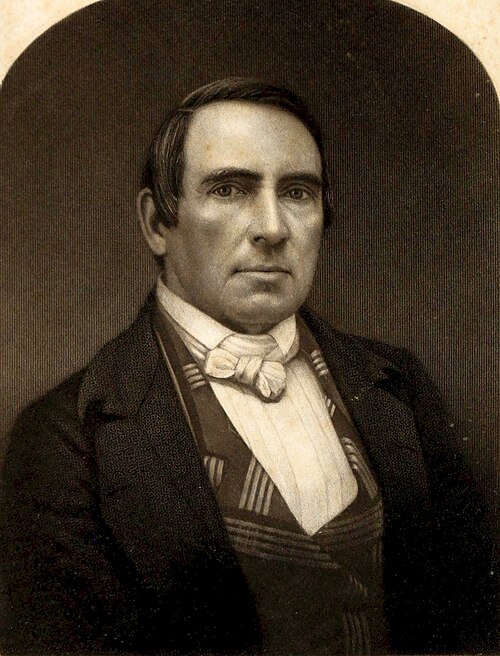
James Gillespie Blaine was an American statesman and Republican politician who represented Maine in the United States House of Representatives from 1863 to 1876, served as Speaker of the House from 1869 to 1875, and was a United States senator from 1876 to 1881. He served twice as Secretary of State, under presidents James A. Garfield and Chester A. Arthur in 1881, and under Benjamin Harrison from 1889 to 1892. He sought the Republican presidential nomination in 1876 and 1880, and received the nomination in 1884, narrowly losing the general election to Democratic nominee Grover Cleveland. Blaine was a prominent figure in the moderate faction of the Republican Party, known as the "Half-Breeds".
gutenberg.org
But in fact the decision of the Court had only rendered the contest more intense and more bitter.
The Court declared that the Act of Congress prohibiting slavery in the Territories north of 36 deg. 30' was unconstitutional and void.
The distinct and avowed marshalling of a solid North against a solid South had begun, and the result of the Presidential election of 1856 settled nothing except that a mightier struggle was in the future.
In 1857 a party distinctly and unequivocally pledged to resist the extension of slavery into free territory had control of eleven free States and was hotly contesting the possession of the others.
Freedom or slavery in the Territories was to be fought to the end, without flinching, and without compromise.
The Democrats were mortified and astounded by the large popular vote against them.
Indeed, the moral triumph was theirs, and they believed that the actual victory at the polls was only postponed.
The Republicans, far from being discouraged, felt and acted as men who had won the battle.
Votes by tens of thousands declared that they did not desire a Union which was held together by the forbearance or permission of any man or body of men, and they welcomed a test of any character that should determine the supremacy of the…
The condition of affairs in Kansas imparted to his supporters a desperate energy, based on principle and roused to anger.
From such contradictory constructions in the same party, conflicts were certain to arise.
By the other slavery had a foot-hold in the Territories under the Constitution of the United States, and could not be dislodged or disturbed by the inhabitants of a Territory even though ninety-nine out of every hundred were opposed to it.
By the one, slavery could never enter a Territory unless the inhabitants thereof desired and approved it.
The Democratic doctrine of the North and the Democratic doctrine of the South were, therefore, in logic and in fact, irreconcilably hostile.
In fine, the Republicans declared in plain terms that slavery should by positive law of the nation be excluded from the Territories.
He belonged to the past, the party was looking to the future.
It accepted the issue as presented by the men of the South, and it offered no compromise.
The Democracy saw at once that a new and dangerous opponent was in the field,--an opponent that stood upon principle and shunned expediency, that brought to its standard a great host of young men, and that won to its service a very large…
He was a necessity to the South, a necessity to his party; and against the combined force of all the ambitious men who sought the place, he was nominated.
But the very sources of his strength were the sources of his weakness.
All these facts combined--his romantic history, his unflinching steadiness of purpose, his unswerving devotion to the Union--would have made him an irresistibly strong candidate had he been presented.
Houston vindicated their right to speak and did battle for them with a warmth and zeal which specially commended him to Northern sympathy.
He had gained great popularity in the South by his course in repealing the Missouri Compromise, but he had been visited with signal condemnation in the North.
He was pertinently reminded that the evil he might prevent would never be known, whereas the evil to which he consented would be read of all men.
Politicians like James Blaine