It had added many drops to the cup of bitterness between North and South, and had filled it to overflowing.
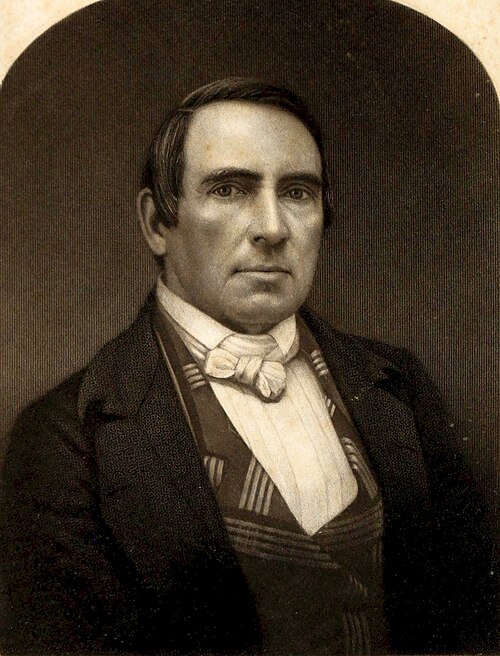
James Blaine
The Public Record
James Gillespie Blaine was an American statesman and Republican politician who represented Maine in the United States House of Representatives from 1863 to 1876, served as Speaker of the House from 1869 to 1875, and was a United States senator from 1876 to 1881. He served twice as Secretary of State, under presidents James A. Garfield and Chester A. Arthur in 1881, and under Benjamin Harrison from 1889 to 1892. He sought the Republican presidential nomination in 1876 and 1880, and received the nomination in 1884, narrowly losing the general election to Democratic nominee Grover Cleveland. Blaine was a prominent figure in the moderate faction of the Republican Party, known as the "Half-Breeds".
gutenberg.org
She had at last a free vote, and rejected the Lecompton Constitution, land grant and all, by a majority of more than ten thousand.
She had fought too long for freedom to be bribed to the support of slavery.
But Kansas would not sell her birthright for a mess of pottage.
Twelve Democrats, to their honor be it said, refused to yield.
It was simply a bribe, cunningly and unscrupulously contrived, to induce the people of Kansas to accept a pro-slavery constitution.
Douglas frankly avowed that he did not care whether slavery was voted up or voted down, but he demanded that an honest, untrammeled ballot should be secured to the citizens of the Territory.
If Kansas should become a slave State in consequence of that repeal, it would, in the excited condition of the popular mind, crush Douglas in the North, and bring his political career to a discreditable end.
If the Missouri Compromise had not been repealed, a free State was assured.
Douglas saw that if he should aid in that political crime he would lose Illinois.
The attempt to admit Kansas, under the Lecompton Constitution, proved disastrous to the Democratic party.
The constitution no more represented the will or the wishes of the people of Kansas than of the people of Ohio or Vermont.
It is not possible, without using language that would seem immoderate, to describe the enormity of the whole transaction.
The whole contrivance was fraudulent, wicked, and in retrospect incredible.
Whatever harm he may have done in that decision was speedily overruled by war, and the country can now contemplate a venerable jurist, in robes that were never soiled by corruption, leading a long life of labor and sacrifice, and achieving…
More allowance is made for the excitement and for what he believed to be the exigency of the hour, for the sentiments in which he had been educated, for the force of association, and for his genuine belief that he was doing a valuable work…
While, therefore, time has in no degree abated Northern hostility to the Dred Scott decision, it has thrown a more generous light upon the character and action of the eminent Chief Justice who pronounced it.
The decision was at war with the practice and traditions of the government from its foundation, and set aside the matured convictions of two generations of conservative statesmen from the South as well as from the North.
It was unmistakably held that ownership in slaves was as much entitled to protection under the Constitution in the Territories of the United States as any other species of property, and that Congress possessed no power over the subject…
Lincoln, whose singular powers were beginning to be appreciated, severely attacked the decision in a public speech in Illinois, not merely for its doctrine, but for the mode in which the decision had been brought about, and the obvious…
Perhaps in the whole history of judicial decisions no two opinions were ever so widely read by the mass of people outside the legal profession.
It upheld with unanswerable arguments the absolute right of Congress to prohibit slavery in all the Territories of the Union.
It represented the well-settled conclusion of the most learned jurists, was in harmony with the enlightened conscience of the North, and gave a powerful rallying-cry to the opponents of slavery.
His opinion became, therefore, of inestimable value to the cause of freedom.
Instead, therefore, of strengthening the Democratic party, the whole effect of the Dred Scott decision was to develop a more determined type of anti-slavery agitation.
Politicians like James Blaine