The South saw that the ablest leader of the Northern Democracy had been compelled, in order to save himself at home, to abjure the very doctrine on which the safety of slave institutions depended.
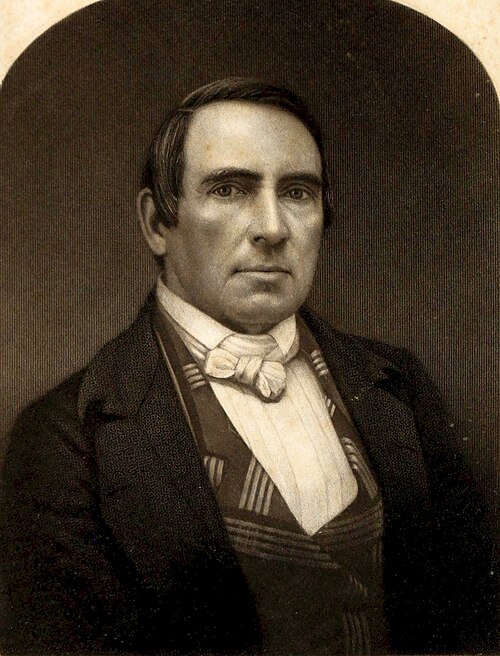
James Blaine
The Public Record
James Gillespie Blaine was an American statesman and Republican politician who represented Maine in the United States House of Representatives from 1863 to 1876, served as Speaker of the House from 1869 to 1875, and was a United States senator from 1876 to 1881. He served twice as Secretary of State, under presidents James A. Garfield and Chester A. Arthur in 1881, and under Benjamin Harrison from 1889 to 1892. He sought the Republican presidential nomination in 1876 and 1880, and received the nomination in 1884, narrowly losing the general election to Democratic nominee Grover Cleveland. Blaine was a prominent figure in the moderate faction of the Republican Party, known as the "Half-Breeds".
gutenberg.org
Lincoln's victory and defeat combined in the end to promote his political fortunes, and to open to him the illustrious career which followed.
But the victory of Douglas and the means by which it was won proved to be his destruction in the wider field of his ambition.
The courage with which he fought the administration gave an air of heroism to his canvass and prestige to his position.
Those police regulations can only be established by the local legislature; and, if the people are opposed to slavery, they will, by unfriendly legislation, effectually prevent the introduction.
He answered that, regardless of the decision of the Supreme Court, "the people of a Territory have the lawful means to introduce or exclude slavery as they choose, for the reason that slavery cannot exist unless supported by local police…
The public mind saw but one issue; every thing else was irrelevant.
Either the opponents of slavery will arrest the farther spread of it, and place it where the public mind shall rest in the belief that it is in the course of ultimate extinction, or its advocates will push it forward till it shall become…
I do not expect the Union to be dissolved; I do not expect the house to fall; but I do expect it will cease to be divided.
His words did not flow in an impetuous torrent as did those of Douglas, but they were always well chosen, deliberate, and conclusive.
He often taught a great truth with the felicitous brevity of an AEsop fable.
He had an abounding sense of humor, and always employed it in illustration of his argument,--never for the mere sake of provoking merriment.
He did not resort to fallacy, and could detect it in his opponent, and expose it with merciless directness.
He did not seek to say merely the thing which was best for that day's debate, but the thing which would stand the test of time and square itself with eternal justice.
He had for himself marked out a path of duty, and he walked in it fearlessly.
He had given anxious thought to the problems of free government, and to the destiny of the Republic.
He would not argue from a false premise, or be deceived himself or deceive others by a false conclusion.
He could lead a crowd almost irresistibly to his own conclusions.
The Democratic party was rent with faction, and the Administration was irrevocably opposed to the return of Douglas to the Senate.
The Republican party was young, strong, united, conscious of its power, popular, growing.
The completeness of that victory was everywhere recognized, and the lawless intruders who had worked so hard to inflict slavery on the new Territory gradually withdrew.
Douglas had, in large degree, redeemed himself in the North from the obloquy to which he had been subjected since the repeal of the Missouri Compromise.
Confidence, the plant of slowest growth, had been destroyed.
In the Southern States it was viewed as an honest effort to recover rights of which they had been unjustly deprived.
The repeal, in the judgment of the North, was a great conspiracy against human freedom.
Politicians like James Blaine