Even a suggestion for its amelioration was regarded as dangerous to the safety of the State and to the sacredness of the family.
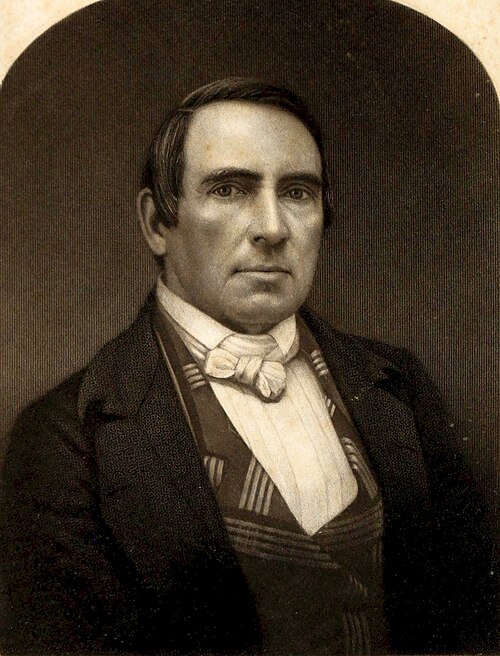
James Blaine
The Public Record
James Gillespie Blaine was an American statesman and Republican politician who represented Maine in the United States House of Representatives from 1863 to 1876, served as Speaker of the House from 1869 to 1875, and was a United States senator from 1876 to 1881. He served twice as Secretary of State, under presidents James A. Garfield and Chester A. Arthur in 1881, and under Benjamin Harrison from 1889 to 1892. He sought the Republican presidential nomination in 1876 and 1880, and received the nomination in 1884, narrowly losing the general election to Democratic nominee Grover Cleveland. Blaine was a prominent figure in the moderate faction of the Republican Party, known as the "Half-Breeds".
gutenberg.org
The South would see no way of dealing with Slavery except to strengthen and fortify it at every point.
Each year the hatred against the North deepened, and the boundary between the free States and the slave States was becoming as marked as a line of fire.
The peaceful revolution was complete when Abraham Lincoln was chosen President of the United States.
They accepted as their leader the man who proclaimed these truths.
They had come to believe that the house divided against itself could not stand; that the Republic half slave, half free, could not endure.
If the compromises of those years could not be maintained, the North believed that all compromise was impossible; and they prepared for the struggle which this fact foreshadowed.
Lincoln gained steadily and derived great strength from the division of his opponents.
If a President, constitutionally elected, could not be inaugurated, it was better then and there to ascertain the fact than to postpone the issue by an evasion or a surrender.
It permitted what was considered a grievous moral wrong to be upheld, if a majority of white men would vote in favor of upholding it.
Lincoln was in favor of prohibiting the extension of slavery by law.
In the four Presidential tickets in the field, every shade of political opinion was represented, but only two of the candidates embodied positive policies.
Hamlin proved a source of strength, and the imparted confidence and courage to the great movement against the Democratic party.
The discipline of defeat was endured with grace, and self-abnegation was accepted as the supreme duty of the hour.
The devotion to the cause was so sincere and so dominant, that the personal ambitions of a lifetime were subordinated in an instant upon the demand of the popular tribunal whose decision was final.
In monarchical governments it has dethroned kings, and in republics it dictates candidates.
The power of the mob in controlling public opinion is immeasurable.
Even those who most decidedly differed from him followed him from one delegation to another allured by the charm of his words.
He grasped a subject with a giant's strength, presented its strong points, and marshaled its details with extraordinary power.
His influence, more than that of any other man, had broken down the proscriptive creed of the American party, and turned its members into the Republican ranks.
In battling for the rights of the negro, he deemed it unwise and inconsistent to increase the disabilities of the foreign-born citizen.
Such a feeling is contagious, and it spread from that centre until it enveloped the free States.
Confidence of strength is as potential an element in a political canvass as in a military campaign, and never was a more defiant sense of power exhibited than by the Chicago convention of 1860 and by the vast throng which surrounded its…
The South was implacable toward Douglas, and deliberately resolved to accept defeat rather than secure a victory under his lead.
Had the Democracy presented Douglas and Breckinridge as their National nominees, they would have combined all the elements of strength in their party.
Politicians like James Blaine