Spontaneous in impulse, momentary in duration, simple in form, it was yet one of the most striking tributes ever paid to moral dignity and lofty character.
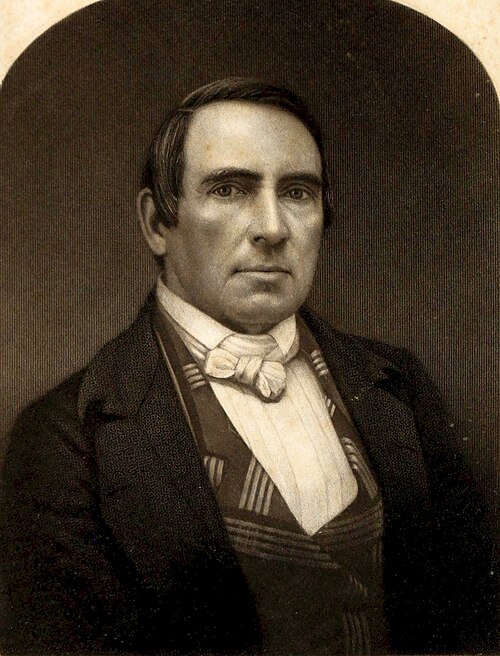
James Blaine
The Public Record
James Gillespie Blaine was an American statesman and Republican politician who represented Maine in the United States House of Representatives from 1863 to 1876, served as Speaker of the House from 1869 to 1875, and was a United States senator from 1876 to 1881. He served twice as Secretary of State, under presidents James A. Garfield and Chester A. Arthur in 1881, and under Benjamin Harrison from 1889 to 1892. He sought the Republican presidential nomination in 1876 and 1880, and received the nomination in 1884, narrowly losing the general election to Democratic nominee Grover Cleveland. Blaine was a prominent figure in the moderate faction of the Republican Party, known as the "Half-Breeds".
gutenberg.org
If it did not go as far as the Abolitionists in their extreme and uncompromising faith might demand, it yet took a long step forward, and afforded the ground on which the battle of the giants was to be waged, and possibly decided.
The consecration of the territory of the United States to freedom became from that day a rallying cry for every shade of anti-slavery sentiment.
The Wilmot Proviso absorbed the attention of Congress for a longer time than the Missouri Compromise: it produced a wider and deeper excitement in the country, and it threatened a more serious danger to the peace and integrity of the Union.
He thereupon, on the 8th of August, 1846, moved a proviso to the two-million bill, declaring it to be "an express and fundamental condition to the acquisition of any territory from Mexico, that neither slavery nor involuntary servitude…
He knew that the two-million bill was urged by the President because he wished to use the money to promote the acquisition of territory, and he determined then and there to make a stand in favor of free soil.
He believed the time had come to arrest the progress and extension of slavery.
He ably vindicated the policy of marching a military force into the territory between the Nueces and the Rio Grande, by the fact that he was memorialized to do so by the still existing Congress of Texas, on the urgent plea that Mexico was…
The Mexican war had scarcely begun when the President justified the popular suspicion by making known to Congress that one of its objects was to be the acquisition of territory beyond the Rio Grande.
The contrast between the boldness with which the Polk administration had marched our army upon the territory claimed by Mexico, and the prudence with which it had retreated from a contest with Great Britain, after all our antecedent…
For the first and only time in our political history, an administration conducting a war victorious at every step, steadily lost ground in the country.
They were young, ardent, enthusiastic, brave almost to recklessness, with a fervor of devotion to their country's honor.
No finer body of men ever enlisted in an heroic enterprise than those who volunteered to bear the flag in Mexico.
But all agreed that it was too late to consider any thing except the honor of the country, now that actual hostilities had begun.
They must either vote for what they did not believe, or, by voting against the bill, incur the odium which always attaches to the party that fails by a hair's-breadth to come to the defense of the country when war is imminent.
The generous instincts of the people condemned an attempt to destroy the honorable fame of a public man by what they considered to be an act of spiteful persecution.
His course saved the administration, not indeed from a mortifying position, but from a continually increasing embarrassment which seemed to force upon the country the cruel alternatives of war or dishonor.
But the entire country suffered, and probably endured a serious and permanent loss, from the false step taken by men who claimed what they could not defend and did not mean to defend.
It was originated as a cry to catch votes; and except with the ignorant, and the few whose judgment was carried away by enthusiasm, it was from the first thoroughly insincere.
But a striking and useful lesson would be lost if it should be forgotten that the country was brought to the verge of war by the proclamation of a policy which could not be, and was not intended to be, enforced.
Future generations would hold the governing power in both countries guilty of a crime if war should ever be permitted except upon the failure of every other arbitrament.
Wise statesmen of that day felt, as wise statesmen of subsequent years have more and more realized, that a war between Great Britain and the United States would not only be a terrible calamity to both nations, but that it would stay the…
Taking the question, however, as it stood in 1846, the settlement must, upon full consideration and review, be adjudged honorable to both countries.
There was scarcely a spot on the globe, outside of the United Kingdom, where we could not have fought England with greater advantage than on the north-west coast of America at that time.
There is no doubt whatever that the English Government would have gone to war rather than surrender the territory north of the 49th parallel.
Politicians like James Blaine