In its progress the struggle absorbed the thought, the action, the passion, of the whole people.
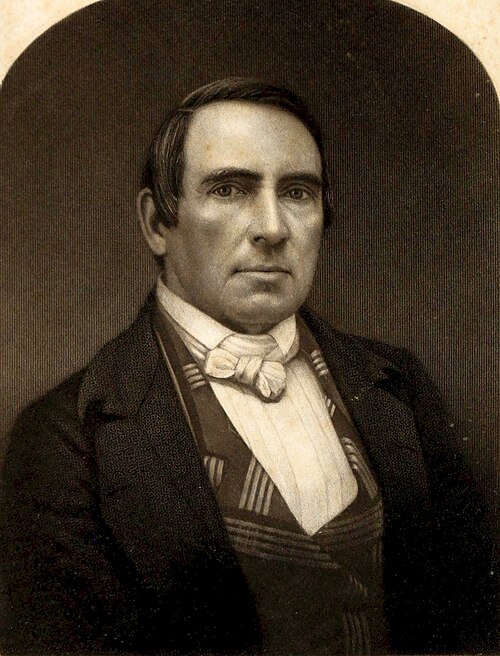
James Blaine
The Public Record
James Gillespie Blaine was an American statesman and Republican politician who represented Maine in the United States House of Representatives from 1863 to 1876, served as Speaker of the House from 1869 to 1875, and was a United States senator from 1876 to 1881. He served twice as Secretary of State, under presidents James A. Garfield and Chester A. Arthur in 1881, and under Benjamin Harrison from 1889 to 1892. He sought the Republican presidential nomination in 1876 and 1880, and received the nomination in 1884, narrowly losing the general election to Democratic nominee Grover Cleveland. Blaine was a prominent figure in the moderate faction of the Republican Party, known as the "Half-Breeds".
gutenberg.org
With him the struggle was not only one of principle, but of pride; not merely of judgment, but of temper; and he communicated to the legions throughout the country, who regarded him with reverence and gratitude, a full measure of his own…
All the enmities and exasperations which began in the memorable contest for the Presidency when John Quincy Adams was chosen, and had grown into great proportions during the long intervening period, were fought out on the angry field of…
No contest for the Presidency, either before or since, has been conducted with such intense energy and such deep feeling.
Clay realized that it was his position on the Texas question, as defined in the Raleigh letter, which was endangering his prestige in Kentucky.
By this aggressive policy the Democratic party called forth the enthusiasm of the people, both North and South, in favor of territorial acquisition,--always popular with men of Anglo-Saxon blood, and appealing in an especial manner to the…
The support of Cass was not sincere, but it served for the moment to embarrass the friends of Van Buren, to make the triumph of what Benton called the Texas conspiracy more easy and more sure, and in the end to lay up wrath against the day…
For the first time in history of any convention, of either party, a candidate supported by a majority of the delegates failed to be nominated.
He feared that European influence might become dominant in the new republic, and, as a consequence, that anti-slavery ideas might take root, and thence injuriously affect the interests, and to some extent the safety, of the Southern States.
He saw with equal clearness that it had never been presented in such manner as to appeal to the popular judgment, and become an active, aggressive issue in the struggle for the Presidency.
He saw intuitively that the Texas question was one of vast importance, with untold possibilities.
With quick observation and keen insight, however, he perceived a great opportunity to serve the South, and to serve the South was with him not only a principle, but a passion.
Soon after the failure of the Abolitionists to exhibit popular strength, the slavery question was forced upon public attention independently of their efforts, and by causes whose operation and effect were not distinctly forseen by those…
They had not failed to observe, that, while few were disposed to unite in extreme anti- slavery measures, there was a growing number whose conscience was aroused on the general subject of human bondage.
Any less earnest body of men would have been discouraged, but the Abolition party was composed of devotees possessing the true martyr spirit, and, instead of being appalled by defeat, they were inspired with fresh zeal, and incited to new…
They were willing to fight for the right of the Abolitionists to do a certain thing, and then willing to fight the Abolitionists for aimlessly and uselessly doing it.
Indeed, by an apparent contradiction not difficult to reconcile, many of those who fought bravely for the right of the Abolitionists to be heard in Congress by petition, were yet enraged with them for continually and, as they thought…
In truth it required no small degree of moral courage to take position in the ranks of that despised political sect forty-five years ago.
It resembled in its character the re-actionary and tyrannical edicts so frequently employed in absolute governments, and was unsuited to the temper, ran counter to the judgment, and proved offensive to the conscience, of the American…
On this incidental issue he forced the controversy until it enlisted the attention of the entire country.
Undaunted by any form of opposition, the Abolitionists stubbornly maintained their ground, and finally succeeded in creating a great popular excitement by insisting on the simple right of petition as inseparable from free government and…
Among these Frederick Douglass was especially and richly endowed not only with the strength but with the graces of speech; and for many years, from the stump and from the platform, he exerted a wide and beneficent influence upon popular…
The party was small in number, but its membership was distinguished for intellectual ability, for high character, for pure philanthropy, for unquailing courage both moral and physical, and for a controversial talent which has never been…
While encountering, on these issues, the active hostility of the great mass of the people in all sections of the Union, the Abolitionists challenged the respect of thinking men, and even compelled the admiration of some of their most…
In the gloomiest hour of the Revolutionary war I never had any apprehensions equal to those which I feel from this source." Men on both sides of the controversy began to realize its significance and to dread its probable results.
Politicians like James Blaine