While the measure was pending in Congress, he wrote to a member of the House of Representatives, that "the Missouri question is the most portentous one which has ever threatened the Union.
James Blaine
The Public Record
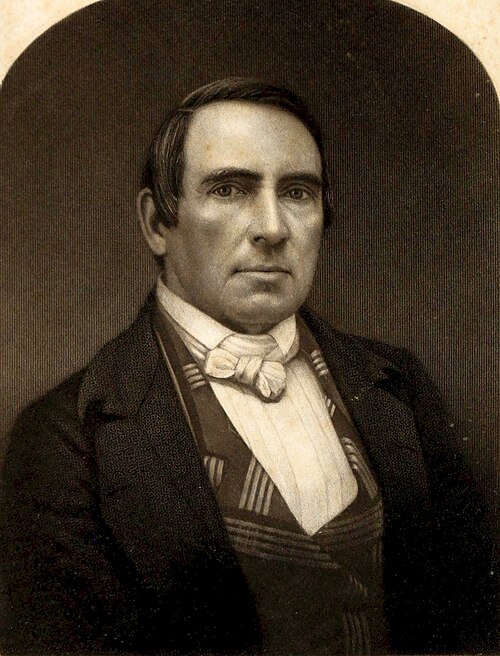
James Gillespie Blaine was an American statesman and Republican politician who represented Maine in the United States House of Representatives from 1863 to 1876, served as Speaker of the House from 1869 to 1875, and was a United States senator from 1876 to 1881. He served twice as Secretary of State, under presidents James A. Garfield and Chester A. Arthur in 1881, and under Benjamin Harrison from 1889 to 1892. He sought the Republican presidential nomination in 1876 and 1880, and received the nomination in 1884, narrowly losing the general election to Democratic nominee Grover Cleveland. Blaine was a prominent figure in the moderate faction of the Republican Party, known as the "Half-Breeds".
gutenberg.org
But no political organization can live without opposition.
The North could easily justify itself by argument, but the statement without argument apparently showed that the South had been deceived.
A feeling that bad faith had been practiced is sure to create bitterness, and the accusation of it produces increased bitterness in return.
Despite the eloquence and the great influence of the Speaker, the Southern representatives were overborne and the House adopted the anti-slavery restriction.
Southern men were unwilling that Maine should be admitted unless the enabling Act for Missouri should be passed at the same time, and Northern men were unwilling that any enabling Act should be passed for Missouri which did not contain an…
Geographically remote, differing in soil, climate, and products, incapable of competing with each other in any pursuit, they were thrown into rivalry by the influence of the one absorbing question of negro slavery.
The outbreak was so sudden, its course so turbulent, and its subsidence so complete, that for many years it was regarded as phenomenal in our politics, and its repetition in the highest degree improbable if not impossible.
A violent agitation at once arose, continued for two years, and was finally allayed by the famous compromise of 1820.
If the weight of reason had not already been on the side of admitting Louisiana, the necessities of war would have enforced it.
The advantage of a loyal and devoted population at New Orleans, identified in interest and in sympathy with the government, was too evident to need argument.
A majority of the people, both North and South, were convinced that the ownership of the mouth of the Mississippi was of inestimable value to the Union, and that it could not be permanently secured except by admitting as a State the…
Many Northern men had opposed the purchase of the territory from France, believing it to be unconstitutional; and they dreaded the introduction of senators and representatives from territory which they considered foreign.
Opposition to it was not, however, grounded so much upon the existence of slavery as upon the alleged violation of the Constitution in forming a State from territory not included in the original government of the Union.
Louisiana sought to enter the Union in 1811, and then for the first time occurred an agitation in Congress over the admission of a slave State.
Thus all boundary disputes with Spain were ended, and peace was secured, though at a great cost; as events in after years so fully proved.
The whole of Florida was ceded by Spain, an acquisition which proved of great value to us in every point of view.
To compose the boundary troubles with Spain, a treaty was negotiated in 1819, which, with many gains, entailed some signal losses upon the United States.
In the vexatious war with the Seminoles, General Jackson did not hesitate to march across the line, capture Pensacola, and seize the Barancas.
The success of the Lewis and Clarke expedition aided greatly in sustaining our title to the Oregon country.
The obvious reason is that she dreaded the complication of a war in America when she was about to assume so heavy a burden in the impending European conflict.
This fact was clearly seen by Bonaparte when he hastily made the treaty ceding it to the United States.
No colonial acquisition ever made by her on any continent has been so profitable to her commerce, and so strengthening her military position, as that of Louisiana would have proved.
England would thus have had her colonies planted on the three land-sides of the Union, while on the ocean-side her formidable navy confronted the young republic.
If England had seized Louisiana, as Bonaparte feared, the Floridas, cut off from the other colonies of Spain, would certainly have fallen into her hands by easy and prompt negotiation, as they did, a few years later, into the hands of the…
Politicians like James Blaine