Full liberty to criticise the acts of persons in official station, free agitation of all political questions, frequent elections that give opportunity for prompt settlement of all issues, tend to insure popular content and public safety.
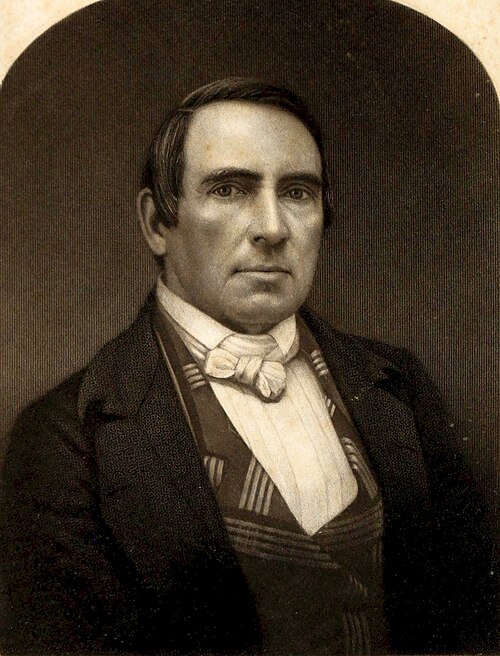
James Blaine
The Public Record
James Gillespie Blaine was an American statesman and Republican politician who represented Maine in the United States House of Representatives from 1863 to 1876, served as Speaker of the House from 1869 to 1875, and was a United States senator from 1876 to 1881. He served twice as Secretary of State, under presidents James A. Garfield and Chester A. Arthur in 1881, and under Benjamin Harrison from 1889 to 1892. He sought the Republican presidential nomination in 1876 and 1880, and received the nomination in 1884, narrowly losing the general election to Democratic nominee Grover Cleveland. Blaine was a prominent figure in the moderate faction of the Republican Party, known as the "Half-Breeds".
gutenberg.org
The self-restraint which the citizens of the Republic exhibited in the hour of need, the great burdens which they bore under the inspiration of patriotic duty, the public order which they maintained by their instinctive obedience to the…
Not simply to the leading statesmen of the Senate and the House, but to Congress as a whole, in its aggregate wisdom,--always greater than the wisdom of any one man,--credit and honor are due; due for intelligence, for courage, for zeal in…
It could not have been made except under wise laws, honestly and impartially administered.
Such progress is not only unprecedented but phenomenal.
The provision made for those who suffered in the civil war has perhaps no parallel at home or abroad.
No period of history had been more marked by generous expenditure for worthy ends.
It is no exaggeration to say that the construction and repair of railway lines in the twenty years preceding 1881 involved an expenditure of money larger than the total National debt at the close of the war.
Lincoln, in the midst of gigantic outlays for the war, authorized the building of the Pacific Railroad, and successfully used the Government credit to complete it in less time than the State-rights' leaders had been abortively debating the…
The dominance of the State-rights' school had created in the minds of the people a distrust of the power of the General Government,--a fact which no doubt was taken into the calculations of those who revolted against its authority.
A common danger awakened them to a sense of their aggregate strength, and that awakening proved to be the beginning of a new progress.
Congress had the foresight, the philanthropy, the courage to choose the latter course, and to transform four millions of slaves into four millions of citizens.
With the National arms triumphant, with the Union of the States made strong, the American people, in the quiet of domestic peace, in the enjoyment of wide-spread prosperity, should not forget the dangers and sacrifices which secured to…
His numbers will ultimately command what should now be yielded on the ground of simple justice and wise policy.
He cannot be permanently held in a condition between the two.
Ceasing to be a slave the colored man must be a citizen.
As this increase continues, no policy could possibly be devised so fatal to Southern prosperity as that which Southern leaders have pursued since the close of the war.
The growth of the country will ultimately effect an adjustment, but the reason of men should not wait for the mere power of numbers to settle questions which properly belong in the domain of reason alone.
But consolidation on one side leads naturally and always to consolidation on the other side.
Contention between sections, divided by a fixed line, is the most undesirable form of political controversy.
He only desires that every individual in the South, as in the North, shall control his own vote, and when that is done the result, whatever it may be, will always be cheerfully accepted.
No man in the North, valuing the freedom for which a great war was waged, desires to control the vote of a single individual in the South.
Diversity of employment, the spirit of industrial enterprise, the unification of financial interests, will tend more and more to assimilate the populations, more and more to enforce an agreement, if not as to measures, yet assuredly as to…
Principle will re-assert itself; local and state interest will command a change.
It is a contest for equal rights under the Constitution, for simple justice between citizens of the same Republic.
Politicians like James Blaine