England's acquisition of Louisiana would have proved in the highest degree embarrassing, if not disastrous, to the Union.
James Blaine
The Public Record
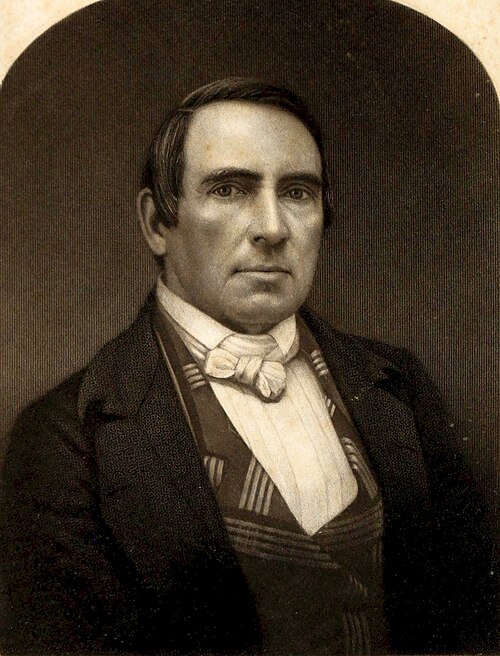
James Gillespie Blaine was an American statesman and Republican politician who represented Maine in the United States House of Representatives from 1863 to 1876, served as Speaker of the House from 1869 to 1875, and was a United States senator from 1876 to 1881. He served twice as Secretary of State, under presidents James A. Garfield and Chester A. Arthur in 1881, and under Benjamin Harrison from 1889 to 1892. He sought the Republican presidential nomination in 1876 and 1880, and received the nomination in 1884, narrowly losing the general election to Democratic nominee Grover Cleveland. Blaine was a prominent figure in the moderate faction of the Republican Party, known as the "Half-Breeds".
gutenberg.org
The purchase of Louisiana may therefore be fairly said to have carried with it and secured to us our possession of Oregon.
It was certainly our purchase of Louisiana that enabled us to secure the Spanish title to the shores of the Pacific, and without that title we could hardly have maintained our claim.
But I require money to make war on the richest nation in the world.
To attempt obstinately to retain it would be folly.
It is not only New Orleans that I will cede, it is the whole colony without any reservation.
But they shall not have the Mississippi, which they covet.
I know the full value of Louisiana, and have been desirous of repairing the fault of the French negotiators who lost it in 1763.
He determined, therefore, to acquire the control of the left bank of the Mississippi to its mouth, and by the purchase of the Floridas to give to Georgia and the Mississippi territory (now constituting the States of Alabama and…
He saw with clear vision that by the commercial disability upon the western section of the Union its progress would be obstructed, its already attained prosperity checked; and that possibly its population, drawn first into discontent with…
Jefferson restrained every movement that might involve us in a war with Spain, from which nothing was to be gained, and by which every thing would be risked.
The ambitions developed by the acquisition of new territory led to serious conflicts of opinion between North and South,--conflicts which steadily grew in intensity until, by the convulsion of war, slavery was finally extinguished.
The opportunity for relief came from remote and foreign causes, without our own agency; but the courageous statesmanship which discerned and grasped the opportunity, deserved, as it has received, the commemoration of three generations.
One of the great problems imposed upon the founders of the Union was to remove the burdens and embarrassments which obstructed the development of the Western States, and thus to render their inhabitants as loyal by reason of material…
Within the limits of the Union as originally formed the slavery question had therefore been compromised, the common territory partitioned, and the Republic, half slave, half free, organized and sent forth upon its mission.
The founders of the government not only looked to the speedy extinction of slavery, but they especially abhorred the idea of a geographical line, with freedom decreed on one side, and slavery established on the other.
This was the first territory of which the General Government had exclusive control, and the prompt prohibition of slavery therein by the Ordinance of 1787 is an important and significant fact.
In each instance the subsequent course of events determined the popularity of unpopularity of similar acts performed with similar motives,--acts altogether honorable, motives altogether patriotic in both cases.
That struggle reached its last peaceable stage in the triumph of Freedom in Kansas and the election of Lincoln to the Presidency.
The great battle between Freedom and Slavery for supremacy in the Territories had been fought and won in Kansas, and the people had elected a Chief Magistrate on Freedom's side, so that the influences of National Administration would no…
In the universal horror which they inspired, in the majestic supremacy of law, which they failed to disturb, may be read the strongest proof of the stability of a Government which is founded upon the rights, fortified by the intelligence…
Neither crime had its origin in the political institutions or its growth in the social organization of the country.
The murder of Garfield was the fatuous impulse of a debauched conscience if not a disordered brain.
The murder of Lincoln was the maddened and aimless blow of an expiring rebellion.
No Government of modern times has encountered the dangers that beset the United States, or achieved the triumphs wherewith the Nation is crowned.
Politicians like James Blaine