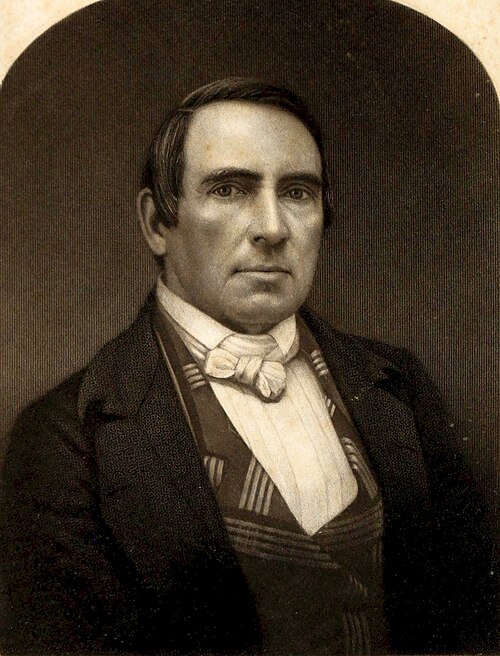
The struggle which this policy invites, nay which it enforces, is as much a moral as a political struggle.
James Blaine
The Public Record
James Gillespie Blaine was an American statesman and Republican politician who represented Maine in the United States House of Representatives from 1863 to 1876, served as Speaker of the House from 1869 to 1875, and was a United States senator from 1876 to 1881. He served twice as Secretary of State, under presidents James A. Garfield and Chester A. Arthur in 1881, and under Benjamin Harrison from 1889 to 1892. He sought the Republican presidential nomination in 1876 and 1880, and received the nomination in 1884, narrowly losing the general election to Democratic nominee Grover Cleveland. Blaine was a prominent figure in the moderate faction of the Republican Party, known as the "Half-Breeds".
gutenberg.org
It comprehends nothing less than the absolute consolidation of sixteen States,--not by liberty of speech, or public discussion, or freedom of suffrage, but by a tyranny of opinion which threatens timid dissentients with social ostracism…
Southern men of all parties would unite against the admission of a Northern State until a Southern State was ready to offset its vote in the Senate, but they never sought to compel unity of opinion throughout all Southern States upon…
But even the equality of representation was for a section and not for a party, and its existence did not prevent the free play of contests on other issues.
The result betokened thenceforth a struggle within the Union far more radical than that which had been carried on from the formation of the Constitution until the secession of the South.
A letter, purporting to have been written by General Garfield, and designed to represent him as approving Chinese immigration to compete with home labor, was cunningly forged.
In the hope of counteracting the effect of the argument for a Protective Tariff in winning the industrial element of the country to Republican support, the Democratic managers concocted one of the most detestable and wicked devices ever…
The Democratic declaration in favor of a tariff for revenue only was turned with tremendous force against that party.
It embodied a fatal declaration in favor of a tariff for revenue only, made vehement utterance on the alleged election fraud of 1876, demanded honest money of coin or paper convertible into coin, and gave a strong pledge against permitting…
He represented the liberal and progressive spirit of Republicanism without being visionary and impractical, and his nomination was accepted as placing the party on advanced ground.
His ascendency in the Convention was so marked as to turn all eyes towards him.
In eloquence, culture, and resources he had few peers.
No statesman of the times surpassed him in thorough acquaintance with the principles of free government, in knowledge of the legislative and administrative history of our own country, and in intelligent grasp of the great questions still…
For twenty years he had been prominent in the public service, both civil and military, and for ten years he had ranked among the foremost Republican leaders.
It was not an escape from the clash of positive purposes by a resort to a negative and feeble expedient.
His dignified bearing, his commanding ability, his persuasive eloquence, and his manifest spirit of fairness had made a profound impression on the Convention.
It was a final blow at the Unit Rule, and aimed to reduce the precedents and decisions of former conventions to plain and unambiguous language.
We are responsible for those votes to our constituents, and to them alone.
We come here as Republicans and we are entitled to take part in the proceedings of this Convention; and as one of our rights we can vote on every resolution, aye or no.
That is the question and that is the whole question.
The discussion was becoming very animated, when General Garfield, in an unimpassioned speech, recalled the Convention to the real question and warned delegates against committing an error.
This decision broke at the outset any attempt to enforce the Unit Rule and affirmed the absolute right of the individual delegate to cast his vote at his own pleasure and upon his own responsibility.
They believed that the example of Washington if now reinforced by the example of Grant would determine the question for the future, and assure a regular and orderly change of rulers, which is the strongest guarantee against the approach of…
But the limit of two terms had become an unwritten part of the code of the Republic, and the people felt that to disregard the principle might entail dangers which they would not care to risk.
With all the respect and affection for the illustrious commander of the Union armies, there was a deep and earnest feeling against a third term.
Politicians like James Blaine