But as has been already set forth in these pages, public opinion in the United States is hostile to any thing that even in appearance indicates a Government control at elections, and most of all a control by the use of the military arm.
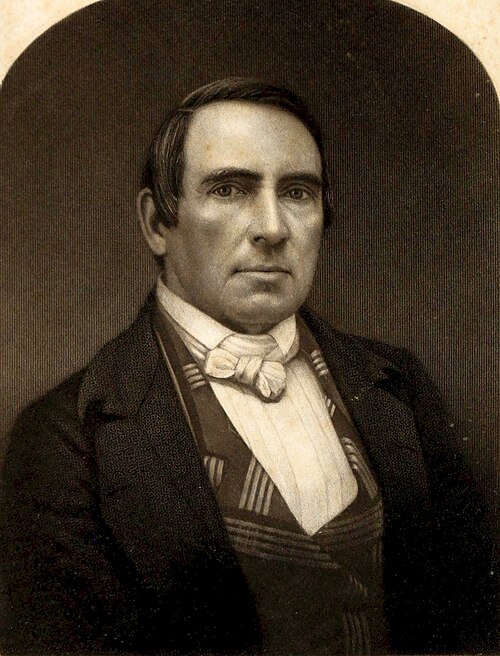
James Blaine
The Public Record
James Gillespie Blaine was an American statesman and Republican politician who represented Maine in the United States House of Representatives from 1863 to 1876, served as Speaker of the House from 1869 to 1875, and was a United States senator from 1876 to 1881. He served twice as Secretary of State, under presidents James A. Garfield and Chester A. Arthur in 1881, and under Benjamin Harrison from 1889 to 1892. He sought the Republican presidential nomination in 1876 and 1880, and received the nomination in 1884, narrowly losing the general election to Democratic nominee Grover Cleveland. Blaine was a prominent figure in the moderate faction of the Republican Party, known as the "Half-Breeds".
gutenberg.org
It would be unjust to the Republicans to say that they demanded military aid with the remotest intention of controlling any man's vote.
He was a man of strong intellect, strong will, and rugged integrity.
It is difficult to speak of these pretensions with respect, or to treat them as honestly put forward by men to whom all the facts were familiar.
The wrong was done when he was selected as third Commissioner, and the tenacity with which he was urged will always require explanation from the British Government.
Every American felt that under such circumstances it was better to pay than to be paid the five and a half million dollars.
His only design was to call the attention of the British Government to the extraordinary facts, and leave to the determination of that Government whether any thing should be done to mitigate the glaring and now demonstrated injustice of…
He was compelled to believe from the magnitude of the award, that considerations foreign to the questions submitted had been brought before the Arbitration.
It produced profound astonishment throughout the United States, accompanied by no small degree of indignation.
The record of this case, as thus shown by the official correspondence, is not creditable to the English Government.
Success was more easily attained with the Executive department of our Government than with the Legislative.
Our Commissioners had very justly maintained that the admission of Canadian fish and fish-oil free of duty into the United States would be more than an equivalent for the fishery rights to be conceded by the British Government.
But the wary diplomatists of England, with sarcasm scarcely concealed, had so phrased the opening clause of the Reciprocity treaty as to make its provisions only "additional to the liberty secured to the United States fishermen by the…
We had risen greatly in the estimation of the world as to our capacity for war, and we had learned the especial importance of maintaining the fisheries as the nursery of our sailors.
The war just concluded with Great Britain had reflected the highest honor upon our navy; while on land we had demonstrated, if not the absolute impossibility, certainly the serious difficulty and danger, of an invasion of our soil by any…
The war of 1812 had satisfied Great Britain that she could gain nothing by going to war with the United States.
There is a right and a wrong side to this questions, and either the Government of the United States or the Government of England is to blame for the chronic contention which marks it.
In those sixteen years the Government expended more than three hundred millions on the Navy!(4) It expended scarcely three millions to aid in building up its mercantile marine, and expended much of that unwisely.
It would abolish the art of ship-building on this side of the Atlantic, would educate no American sailor, except in the coasting trade.
This is the last movement necessary to complete the dominion of Great Britain over the sea, to complete the humiliation of the United States as a commercial country.
Instead of that, we have been constructing the navy as an exotic, forcing it to grow without a favoring atmosphere, establishing it with officers and not with men, educating cadets on land, and not educating sailors on the ocean.
If the Government of the United States had, since the close of the war, expended annually upon the mercantile marine one-fifth of the amount that has been expended upon the Navy, our ships would have covered every sea, and the Navy would…
It is a familiar adage requiring no enforcement of argument, that navies do not grow at the top.
The value of this school for seamen, as one of the arms for National defense, could not have been more strikingly illustrated, or more completely proved.
Every intelligent man knows that it is impossible to maintain a navy unless there be a commercial marine for the education of sailors.
Politicians like James Blaine