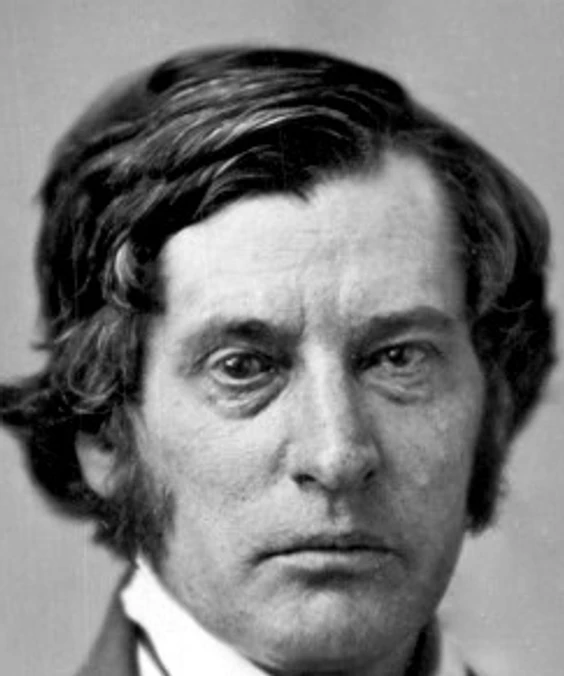
They well know how essential is the sobriety of workmen to the profitableness of their work; they know, too, how wasteful and destructive is inebriety.
Horace Mann
The Public Record
Horace Mann was an American educational reformer, abolitionist and Whig politician known for his commitment to promoting public education; he is thus also known as The Father of American Education. In 1848, after public service as Secretary of the Massachusetts State Board of Education, Mann was elected to the United States House of Representatives (1848–1853). From September 1852 to his death in 1859, he served as President of Antioch College.
gutenberg.org
If I own a farm, or a shop, I may, as owner, prescribe the conditions of its transfer to another.
I want, therefore, no better foundation for legislating over the territories than the fact of ownership in the United States.
Inseparable from the right to sell is the right to define the terms of sale.
Such is the doctrine of the Supreme Court of the United States: “The right to govern,” says Chief Justice Marshall, “may be the inevitable consequence of the right to acquire.” Amer.
What does a buyer pay for, if it be not the right to “dispose of”?
For, for what purpose does any man acquire property but to govern and control it?
If, then, the power to acquire exists, it exists by implication and inference; and if the power to acquire be an implied one, the power to govern what is acquired must be implied also.
Hence the acts we are to perform seem to partake of the nature of creation, rather than of legislation.
Hence their futurity is to depend upon our present action.
Nature works by fixed laws; but we can bring this or that combination of circumstances under the operation of her laws, and thus determine results.
As are the institutions which we form and establish there, so will be the men whom these institutions, in their turn, will form.
I had hoped and intended, either in a public or private capacity, to spend my life in advancing the great cause of the people’s education.
I must add, in closing, that so far as personal preferences are concerned, I infinitely prefer remaining in my present position, with all its labor and its thanklessness, to any office in the gift of the people.
After what I have said above in favor of liberty for all mankind, it would be a strange contradiction did I consent to be myself a slave of party.
Not believing in political pledges, I should have had the honor to decline giving any to you, had you not had the first and greater honor of asking none from me.
When such a dreadful work is doing, or threatens to be done, can any one stand listlessly by, see it perpetrated, and then expect to excuse himself, under the false, impious pretext of Cain, “Am I my brother’s keeper?
The noblest impulses of the human soul, the most sacred affections of the human heart, will die out, when every sphere is closed against their exercise.
The sentiments of truth and duty will die out, when cunning and falsehood can obtain more gratifications than frankness and honesty.
Self-respect will die out, under the ever-present sense of inferiority.
The love of knowledge will die out, when it ceases to be stimulated by the means of knowledge.
Thus will it be with all our God-given faculties, just so far as they are debarred from legitimate exercise upon their appropriate objects.
Thus will it be with our own brethren or children, should we shut up from them the book of knowledge, or seal their senses so that they could not read it.
And this retribution, I believe, will come suddenly, as well as last forever.
That doom will be what our present conduct predestines.
Politicians like Horace Mann