The bill proposes the abolition, not of slavery, but only of the slave trade, in the District of Columbia.
Horace Mann
The Public Record
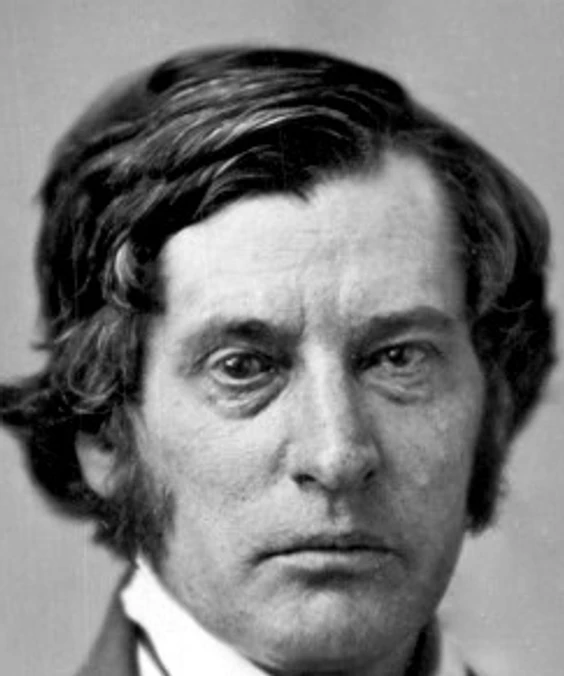
Horace Mann was an American educational reformer, abolitionist and Whig politician known for his commitment to promoting public education; he is thus also known as The Father of American Education. In 1848, after public service as Secretary of the Massachusetts State Board of Education, Mann was elected to the United States House of Representatives (1848–1853). From September 1852 to his death in 1859, he served as President of Antioch College.
gutenberg.org
Even should the bill be taken up, it is probable that all debate upon it will be suppressed by that sovereign silencer,--the previous question.
These, gentlemen, are the facts, and, as I believe, all the important facts pertaining to this case; and on these facts we claim that you must acquit the prisoner of the offence of larceny.
He has not a right to his flesh and bones, so that he can cut up the former for dog’s meat, and grind the latter for compost.
The harshest doctrines in favor of slavery only claim, that a master has a right to the services of his slave.
But if he took them for the purpose of carrying them to a free state, and of thus restoring them to their natural liberty, then he did not intend to convert them to his own use, and is not guilty of stealing.
By the law and force of man, they have been subjected to bondage.
These slaves, by the law of nature, were as free as you or I.
Gracious Heaven! grant me but health, thou great Bestower of it, and give me but this fair goddess as my companion, and shower down thy mitres, if it seems good unto thy divine providence, upon those heads which are aching for them.
With thee to smile upon him as he eats his crust, the swain is happier than his monarch, from whose court thou art exiled.
No tint of words can spot thy snowy mantle, or chemic power turn thy sceptre into iron.
God help thee! said I, but I’ll let thee out, cost what it will; so I turned about the cage to get at the door.
I stood looking at the bird, and to every person who came through the passage, it ran fluttering to the side which they approached, with the same lamentation of its captivity,--‘I can’t get out,’ said the starling.
In my return back through the passage, I heard the same words repeated twice over, and looking up, I saw it was a starling, hung in a little cage. ‘I can’t get out, I can’t get out,’ said the starling.
The latter is gratified a thousand times where the former is once, and therefore the law visits the former with the milder penalty.
But this impulse which prompts to the destruction of another man’s property is vastly weaker than that which leads to its appropriation.
If one man takes the property of another, merely to destroy or annihilate it, out of ill will or revenge towards the owner, this is malicious mischief only, and not stealing.
Hence there is the broadest and most striking difference between stealing and malicious mischief.
The reason why, in each of these cases, one would not be guilty of stealing, is, that he does not mean to make the article taken his own.
The doctrine, gentlemen, which I wish to enforce upon your minds, is, that every act of taking another man’s property is not stealing.
It is not the mere taking of another man’s property, therefore, which constitutes stealing, but the taking of it in order to convert it to the use of the taker, and so to save himself the labor of earning it.
The law denounces its penalties against stealing, in order to repress the excesses of this propensity, and to confine it to honest acquisitions.
And thus, gentlemen of the jury, I say that while some of the seeds of liberty which we scatter are wafted to a foreign realm, and fall upon a foreign soil, others will drop upon the hearts of bondmen and bondwomen at home, and will there…
The tree of liberty will spring up every where, and nations shall recline in its shade.
And even in the barren sands of tyranny they are destined to take root.
Politicians like Horace Mann