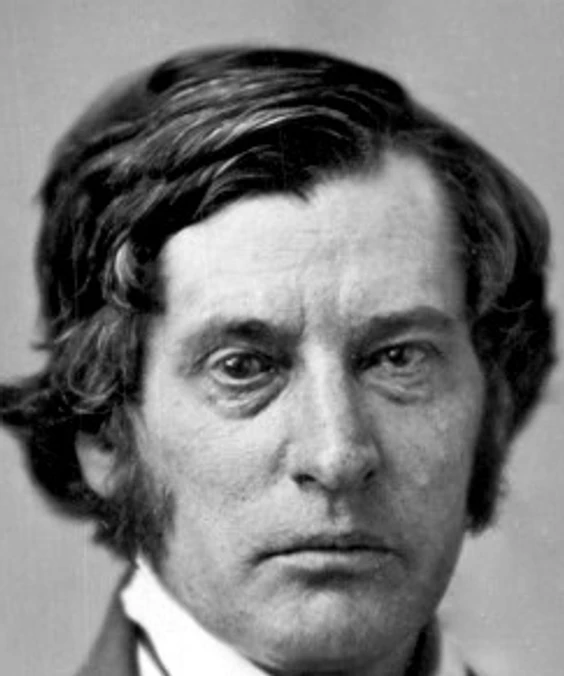
The cases are to be “heard and determined,” as they were under Robespierre, “in a summary manner.” Shakspeareenumerates the “law’s delay” among the causes of suicide.
Horace Mann
The Public Record
Horace Mann was an American educational reformer, abolitionist and Whig politician known for his commitment to promoting public education; he is thus also known as The Father of American Education. In 1848, after public service as Secretary of the Massachusetts State Board of Education, Mann was elected to the United States House of Representatives (1848–1853). From September 1852 to his death in 1859, he served as President of Antioch College.
gutenberg.org
In assailing all we love of liberty, could not the framers and supporters of this measure have forborne to wound us in all we feel of honor!
It provides that if a commissioner will doom a man to bondage, his fee shall be twice as much as though he restores him to liberty.
One of them is so unspeakably mean and contemptible, that all northern men must feel the insult more keenly than the wrong.
It resembles the lettres de cachet, which, before the great revolution, the despots of France gave, in blank, to villain courtiers, and villain courtesans, to be filled up with the names of those persons whose perdition they would compass.
Do you ask where is that old, time-honored writ of habeas corpus, for which martyrs have died and rivers of blood have flowed, and which the constitution declares SHALL NOT be suspended “unless when in cases of rebellion or invasion, the…
All securities for the life, liberty and property of us all, are swept away if such principles can be established.
Such an act violates the first principles of justice.
Who is under so great a disability as he who knows nothing, and can know nothing, of what is going on against him?
It is never permitted, not even to deprive the worst man of the humblest right.
This binding of a man by evidence obtained without his knowledge, is unknown to the common law, and abhorrent to it.
Why not make the whole case provable behind the man’s back,--in another state,--a thousand miles off,--and spurn the forms of justice, after having spurned its substance?
If this be not depriving a person of his “liberty” “without due process of law,” what can be?
This proof may be procured against the alleged fugitive without any notice to him, actual or constructive; without the possibility of his encountering it, or disproving it, however false it may be.
Again, the act consigns a man to bondage, without crime, on evidence which he has had no opportunity to controvert.
This is the identical power which the constitution of the United States vests in judges who are to be nominated by the President, confirmed by the Senate, to hold office during good behavior, and to be compensated by fixed salaries.
I say, then, that, in effect, the commissioner, by this act, has original, final, and exclusive jurisdiction of a “case” “in law,” “arising under the constitution and laws of the United States.” This is the very function of judges and…
But the south grew bolder and bolder, until a law was passed, by which one class of men have less security for their freedom than another class have for their cattle.
He is to decide that a man owes life-long service from himself, and from all the children of his loins.
The constitution declares in whom “the judicial power of the United States shall be vested.” It shall be vested in “one supreme court, and in such inferior courts as Congress may from time to time establish.” No commissioner, nor any…
It provides for the creation of scores and hundreds of officers called “commissioners,” and upon these, it is said on high authority, to confer original and final jurisdiction on questions of human liberty.
Not how much may we do for freedom, but how much can we do for slavery, has been the tacit assumption of the argument.
It has been discussed as though the jury trial, to protect a man’s right to himself, were an evil; and as though the sudden seizure, “summary” adjudication, and speedy consignment of a fellow-being to bondage, were too precious a blessing…
Instead of seeking evasions, and close constructions, and hunting among the musty precedents of darker times, in order to shut out the jury trial in cases of personal liberty, the true lover of freedom would ask only for an interpretation…
In a free government, where the trial by jury is held to be the surest safeguard of personal liberty, the inquiry ought never to be, whether the constitution secures or necessitates this form of trial; for it is enough, if the constitution…
Politicians like Horace Mann