If they would sustain themselves in a competition with us in economical affairs, they must encourage labor and render it honorable.
Horace Mann
The Public Record
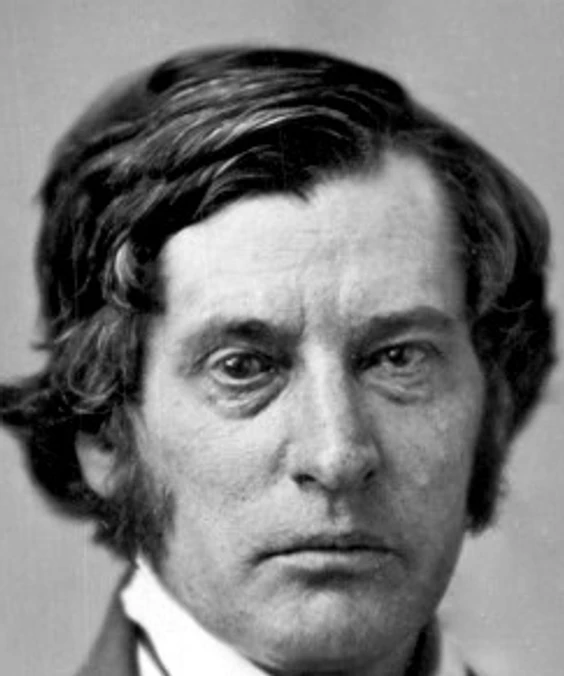
Horace Mann was an American educational reformer, abolitionist and Whig politician known for his commitment to promoting public education; he is thus also known as The Father of American Education. In 1848, after public service as Secretary of the Massachusetts State Board of Education, Mann was elected to the United States House of Representatives (1848–1853). From September 1852 to his death in 1859, he served as President of Antioch College.
gutenberg.org
I do not blame the south for seeking an equilibrium with the north; but they do not seek the true equilibrium.
Would to Heaven that nothing more dear than pecuniary interests had been sacrificed by that measure.
Northern Democrats cast the votes which gave Texas to the south, and destroyed our own prosperity.
The latter suffered in his gains, but the former in his bread.
The laborer suffered even more than the capitalist.
It taught the south the efficacy of clamoring; it taught them that there are cases where a Bombastes Furioso is as powerful as a Julius Cæsar; and it taught them also, notwithstanding all appearances of solidity and firmness, of what a…
Though, on many accounts, I have a high respect for the author of that compromise, yet I regard it as the most unfortunate act ever done,--the most fatal precedent ever set by this government.
He contemned the nonsense as much as he despised the fraud, of the cry that the Union was in danger.
Then occurred a most admirable opportunity to test the strength of our government,--to learn and know whether the pillars of this Union are made of granite or of pipe-stems.
O, that the retributions for that treason had been so terrible, that the coward motive of fear, if not the angel impulse of humanity, might have deterred all men in after times from ever daring to repeat it.
We, and humanity, and all that is dearest to the heart and thoughts of man, might have achieved the victory but for a few cases of foul treachery to the cause of freedom.
This was the first great surrender of principle on the part of the north, and a fatal surrender it was.
The south bought or bullied a sufficient number of the invertebrate creatures whom we send to Congress, and triumphed over us.
The morality and religion of the north thought the time had come to arrest the strides of slavery, and they opposed the application.
The south, whose policy had before secured a territory as large as that of the original thirteen, sought to extend slavery over its whole surface.
Though opposed in its inception by the cities and the merchants, yet it has promoted their prosperity not less than that of the people.
Those of you who have arrived at my age, and are therefore acquainted with the condition of things throughout our country towns thirty years ago, know that the change is almost magical.
Those establishments were founded which have produced so marvellous a change in our household condition, surrounding all with so many comforts, and filling our dwellings with so vast a variety of the refinements and luxuries of life.
The streams were dammed, and the mighty powers of nature were set to spinning and weaving, to dyeing and printing, under the guidance of that genius which had been kindled and nurtured in our schoolhouses.
It put the country upon achieving its second independence,--its independence, at least for the necessaries of life, of foreign mechanics, manufacturers, and artisans, as it had already achieved its political independence of foreign kings…
It revealed the fact that, notwithstanding our political independence, we were, in a commercial sense, most deplorably dependent.
They palsied our industry; and, without industry, men, any where out of Paradise, will be poor.
They brought as great a calamity upon the New England states as it would now be to the south if their whole cotton crop, or to the west if their whole grain crop, were to fail for a series of years.
Very early in our history, as a republic established to maintain the rights of man, an extent of territory was acquired equal to all we possessed before; and this addition accrued to the special advantage of those who maintain, as the…
Politicians like Horace Mann