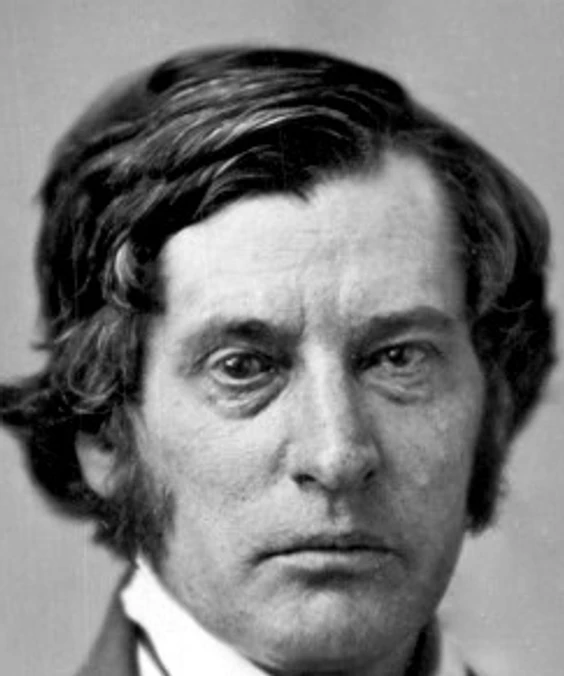
It has always seemed to me that we must protect our labor against foreign labor, or our laborers at home will fall to the condition of the pauper laborers abroad.
Horace Mann
The Public Record
Horace Mann was an American educational reformer, abolitionist and Whig politician known for his commitment to promoting public education; he is thus also known as The Father of American Education. In 1848, after public service as Secretary of the Massachusetts State Board of Education, Mann was elected to the United States House of Representatives (1848–1853). From September 1852 to his death in 1859, he served as President of Antioch College.
gutenberg.org
Any enlargement of business, any increase of profits, any augmentation of wealth, gained by a community through a dereliction from principle, is as insecure and as ignominious as the gains of an individual through fraud, embezzlement, or…
I am an ardent advocate, therefore, of all measures tending to increase the wealth of the country; but on this ever-present and everlasting condition, that it is done without a sacrifice of principles.
We must put society in a condition of physical comfort, before it will rise to mental excellence.
You may find individuals who will be virtuous amid want and privation,--heroes in virtue;--but a virtuous community in rags and hunger, you will never find.
The animal wants of man must be supplied before he will develop his intellectual or moral powers.
If the spirit of thrift does not transgress the limits of honor and duty, it is not only right but laudable.
This, to me, is no cause of regret, but of rejoicing.
Every young man amongst us sets out in life determined to better his condition.
Were we frank and in earnest, or were we hollow and fraudulent?
If territorial bills are presented for the government of New Mexico and Utah, I shall vote for the exclusion of slavery from those territories.
While I desire to do every thing which may protect the rights of property which are guarantied to citizens of the slave states, I cannot consent to sacrifice the rights of liberty which belong to the citizens of the free states.
As God is my judge, I cannot, I will not be moved from the purpose I have now announced.
Never, never will I raise my hand or my voice to give a vote by which it can or may be extended.
But, sir, sir, if the alternative should be presented to me of the extension of slavery, or the dissolution of the Union, I would say, rather than extend slavery, let the Union, ay, the Universe itself be dissolved!
Ay, I would not extend it one sixteen-thousandth part of a hair’s breadth.
But gentleman need not ask me for my vote to extend the institution of slavery one single inch beyond its present boundaries.
And, sir, the constituencies have spoken ‘upon honor.’ They are determined, and will execute their purposes.
The politicians are just as ready now to betray their constituents as they ever have been.
Think you that when I am gone, and he shall grow up to manhood, and shall come forward to act his part among the citizens of the country, I will leave it to be cast in his teeth, as a reproach, that his father voted to send slavery into…
I desire so to acquit myself that my own conscience will not upbraid me, and that when I shall pass away, no reproach shall fall upon me, or my children after me, for my acts here upon this momentous question.
I hold that Congress is bound to take care of the territories, and so execute the trust as will best promote the interests of those who may hereafter be entitled to the beneficial use.
Entertaining no doubt of the constitutional power of Congress to exclude slavery from its own territories, and believing that such exclusion is demanded by the highest principles of morality and justice, she never can consent to its…
Is this what you are to expect from men whom you have elected by your votes, and to whom the momentous interests of millions, and the honor of the country, have been confided, that their vows should be like those of perfidious lovers, who…
Are these “invincible principles” of the Massachusetts Whig legislature to melt, like wax, when touched by the breath of party?
Politicians like Horace Mann