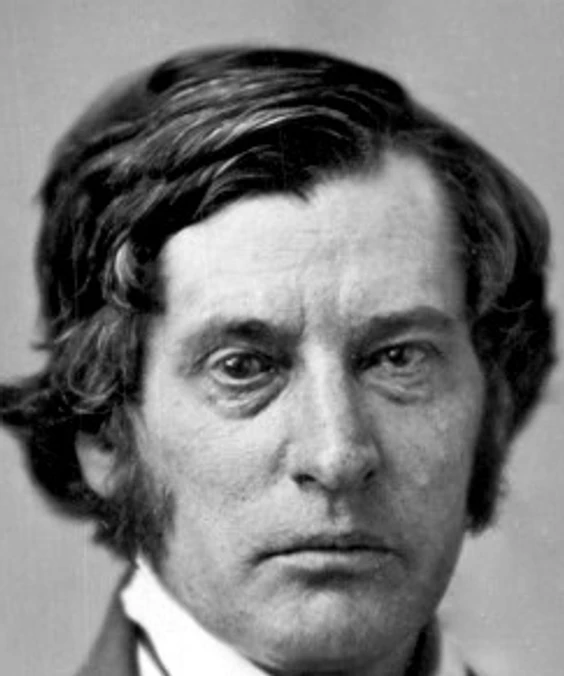
I answer, this benefit at least: that of entering a solemn protest against a grievous wrong, and of placing upon the tablets of my country’s history, what I believe to be the views of a vast majority of my constituents, in common with the…
Horace Mann
The Public Record
Horace Mann was an American educational reformer, abolitionist and Whig politician known for his commitment to promoting public education; he is thus also known as The Father of American Education. In 1848, after public service as Secretary of the Massachusetts State Board of Education, Mann was elected to the United States House of Representatives (1848–1853). From September 1852 to his death in 1859, he served as President of Antioch College.
gutenberg.org
We may be subjected to great sacrifices; but let us sacrifice every thing else, nay, life itself, before we sacrifice our principles.
We may be poor; but let us deprecate and forefend the most calamitous of all poverties,--a poverty of spirit.
Let us beware of the effect of this stimulus upon that nobler portion of our being, which no splendor of opulence nor profusion of luxuries can ever satisfy; which demands allegiance to God, and justice and humanity towards our fellow-men…
My opinion is, that the cause of all our present calamity, and of the enduring dishonor of the late measures, is this very desire to conciliate southern favor, instead of giving a manful defence to northern rights.
Eighteen hundred years ago, it was said that no man can serve two masters; but the cupidity of modern times proposes the solution of a problem which Christ declared to be impossible.
Fellow-citizens, do you suppose that any man can be true to the memory of the Pilgrim fathers, and to the love of liberty they bequeathed us, and at the same time true to the spirit of the Cavaliers, and to the wishes of their slave-owning…
I do regard the question of human freedom for our wide-extended territories, with all the public and private consequences dependent upon it, both now and in all futurity, as first, foremost, chiefest among all the questions that have been…
Before another year is past, will not that most execrable act in modern legislation be palliated or adopted by those who voted for this address?
Perhaps I do not know what I was made for; but one thing I certainly never was made for, and that is, to put principles on and off, at the dictation of a party, as a lackey changes his livery at his master’s command.
If any man offers to vote for me on such conditions, I deny him my assistance and disdain his support.
Like Aristides, I would write the vote that should banish me, rather than to fetter or control the voter’s will.
It is better that animadversion should be wrong than that it should not be free.
I resolved to return to the people, and labor at home instead of at Washington, in the cause of human freedom.
Now it is known to my whole circle of private friends, that, as soon as Congress passed these pro-slavery measures to which I have adverted, my determination was formed not to be a candidate for reëlection.
No, fellow-citizens, the more we yield to the demands of the south in order to save the Union, the more we may and must.
A Union which must be secured by such sacrifices as have been lately made in New York, in behalf of the so called “Union Meeting,” abolishes the benefits it was designed to secure.
But the Union ought to be so used as to extend, and not to abridge human welfare.
And is our love for the Union always to be converted, or rather perverted, into a pro-slavery motive of action?
But an appeal is made to us to ratify this surrender to the slave power, because of our love for the Union.
What have those now to say for themselves, who beguiled a portion of our people into the delusion, that they might safely barter human rights for pecuniary advantages, and have left to their dupes both the loss of the advantages, and the…
Have we got any thing but disgrace in the eyes of the civilized world?
Now where labor is so scantily paid, fabrics can be produced more cheaply; and if these fabrics can be sent into this country, free of duty, they will undersell ours, until the prices of our labor and the condition of our laborers are…
After their day’s work is done, they visit the dram-shops, roam the streets till midnight, and if not invited away by vicious men, they huddle by scores into filthy lodging-houses, where they sleep, men and women promiscuously, till…
In Manchester in England, and Glasgow in Scotland, and many other manufacturing towns in Great Britain, there are thousands of wretched, degraded female operatives, who earn scarcely a shilling a day.
Politicians like Horace Mann