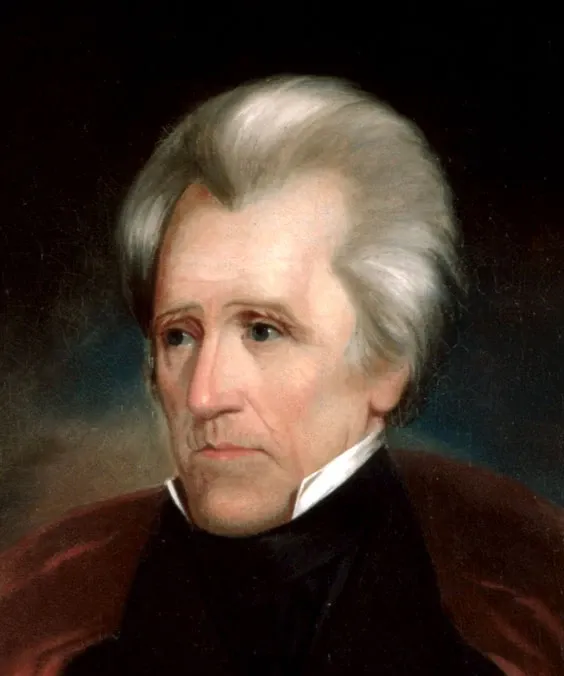
If the guaranties of the Constitution can be broken provisionally to serve a temporary purpose, and in a part only of the country, we can destroy them everywhere and for all time.
Andrew Johnson
The Public Record
Andrew Johnson was the 17th President of the United States, serving from April 15, 1865, to March 4, 1869. A member of the Democratic Party, he was born in Tennessee and became the first president to assume office following the assassination of Abraham Lincoln. Johnson's presidency was characterized by his strong opposition to the Reconstruction policies implemented by Congress, which aimed to rebuild the South and secure rights for newly freed African Americans. His resistance to these policies ultimately led to his impeachment by the House of Representatives in 1868, although he was acquitted by the Senate and remained in office until the end of his term.
gutenberg.org
Arbitrary measures often change, but they generally change for the worse.
It is the curse of despotism that it has no halting place.
The intermitted exercise of its power brings no sense of security to its subjects, for they can never know what more they will be called to endure when its red right hand is armed to plague them again.
Nor is it possible to conjecture how or where power, unrestrained by law, may seek its next victims.
The States that are still free may be enslaved at any moment; for if the Constitution does not protect all, it protects none.
This, to the minds of some persons, is so important that a violation of the Constitution is justified as a means of bringing it about.
The morality is always false which excuses a wrong because it proposes to accomplish a desirable end.
But in this case the end itself is evil, as well as the means.
The blacks in the South are entitled to be well and humanely governed, and to have the protection of just laws for all their rights of person and property.
It is not proposed merely that they shall govern themselves, but that they shall rule the white race, make and administer State laws, elect Presidents and members of Congress, and shape to a greater or less extent the future destiny of the…
Would such a trust and power be safe in such hands?
It follows, therefore, that in admitting to the ballot box a new class of voters not qualified for the exercise of the elective franchise we weaken our system of government instead of adding to its strength and durability.
But the transfer of our political inheritance to them would, in my opinion, be an abandonment of a duty which we owe alike to the memory of our fathers and the rights of our children.
I confidently believe that their descendants will be equal to the arduous task before them, but it is worse than madness to expect that Negroes will perform it for us.
If the inferior obtains the ascendency over the other, it will govern with reference only to its own interests for it will recognize no common interest--and create such a tyranny as this continent has never yet witnessed.
They are taught to regard as an enemy every white man who has any respect for the rights of his own race.
If this continues it must become worse and worse, until all order will be subverted, all industry cease, and the fertile fields of the South grow up into a wilderness.
Of all the dangers which our nation has yet encountered, none are equal to those which must result from the success of the effort now making to Africanize the half of our country.
It has cost uncounted millions already, and if persisted in will add largely to the weight of taxation, already too oppressive to be borne without just complaint, and may finally reduce the Treasury of the nation to a condition of…
The sum thus thrown away would, if properly used, form a sinking fund large enough to pay the whole national debt in less than fifteen years.
With our debt and the vast private interests which are complicated with it, we can not be too cautious of a policy which might by possibility impair the confidence of the world in our Government.
That confidence can only be retained by carefully inculcating the principles of justice and honor on the popular mind and by the most scrupulous fidelity to all our engagements of every sort.
Any serious breach of the organic law, persisted in for a considerable time, can not but create fears for the stability of our institutions.
Habitual violation of prescribed rules, which we bind ourselves to observe, must demoralize the people.
Politicians like Andrew Johnson