If the officer be accused of dishonesty, how shall it be made out?
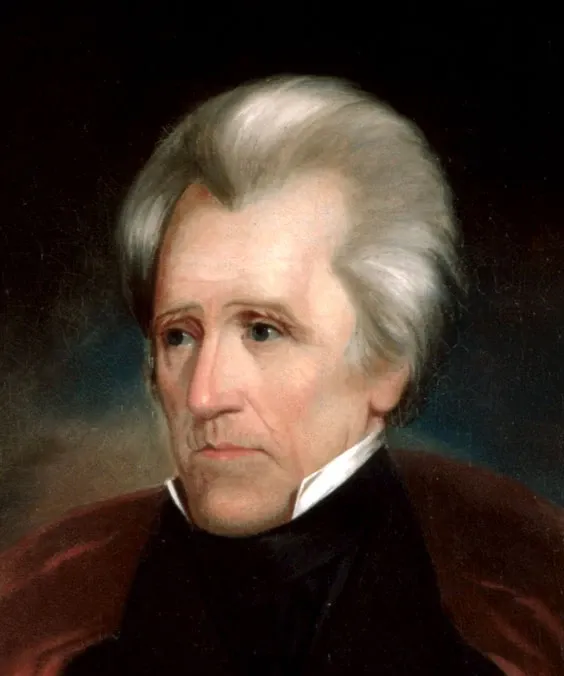
Andrew Johnson
The Public Record
Andrew Johnson was the 17th President of the United States, serving from April 15, 1865, to March 4, 1869. A member of the Democratic Party, he was born in Tennessee and became the first president to assume office following the assassination of Abraham Lincoln. Johnson's presidency was characterized by his strong opposition to the Reconstruction policies implemented by Congress, which aimed to rebuild the South and secure rights for newly freed African Americans. His resistance to these policies ultimately led to his impeachment by the House of Representatives in 1868, although he was acquitted by the Senate and remained in office until the end of his term.
gutenberg.org
Will it be inferred from acts unconnected with public duty, from private history, or from general reputation, or must the President await the commission of an actual misdemeanor in office?
Shall he in the meantime risk the character and interest of the nation in the hands of men to whom he can not give his confidence?
If his zeal in the public service should impel him to anticipate the overt act, must he move at the peril of being tried himself for the offense of slandering his subordinate?
In the present circumstances of the country someone must be held responsible for official delinquency of every kind.
It is extremely difficult to say where that responsibility should be thrown if it be not left where it has been placed by the Constitution.
But all just men will admit that the President ought to be entirely relieved from such responsibility if he can not meet it by reason of restrictions placed by law upon his action.
The unrestricted power of removal from office is a very great one to be trusted even to a magistrate chosen by the general suffrage of the whole people and accountable directly to them for his acts.
The danger to the public service comes not from the power to remove, but from the power to appoint.
Therefore it was that the framers of the Constitution left the power of removal unrestricted, while they gave the Senate a fight to reject all appointments which in its opinion were not fit to be made.
A little reflection on this subject will probably satisfy all who have the good of the country at heart that our best course is to take the Constitution for our guide, walk in the path marked out by the founders of the Republic, and obey…
The law of demand and supply is as unerring as that which regulates the tides of the ocean; and, indeed, currency, like the tides, has its ebbs and flows throughout the commercial world.
Legislation for the accomplishment of a result so desirable is demanded by the highest public considerations.
The Constitution contemplates that the circulating medium of the country shall be uniform in quality and value.
The sages of that period were anxious to protect their posterity from the evils that they themselves had experienced.
Hence in providing a circulating medium they conferred upon Congress the power to coin money and regulate the value thereof, at the same time prohibiting the States from making anything but gold and silver a tender in payment of debts.
They are thus made to occupy an invidious position, which may be used to strengthen the arguments of those who would bring into disrepute the obligations of the nation.
Equal and exact justice requires that all the creditors of the Government should be paid in a currency possessing a uniform value.
These are important facts and show how completely the inferior currency will supersede the better, forcing it from circulation among the masses and causing it to be exported as a mere article of trade, to add to the money capital of…
It is unreasonable to expect a return to a sound currency so long as the Government by continuing to issue irredeemable notes fills the channels of circulation with depreciated paper.
A disordered currency is one of the greatest political evils.
It undermines the virtues necessary for the support of the social system and encourages propensities destructive of its happiness; it wars against industry, frugality, and economy, and it fosters the evil spirits of extravagance and…
It has been asserted by one of our profound and most gifted statesmen that--Of all the contrivances for cheating the laboring classes of mankind, none has been more effectual than that which deludes them with paper money.
This is the most effectual of inventions to fertilize the rich man's fields by the sweat of the poor man's brow.
Ordinary tyranny, oppression, excessive taxation--these bear lightly on the happiness of the mass of the community compared with a fraudulent currency and the robberies committed by depreciated paper.
Politicians like Andrew Johnson