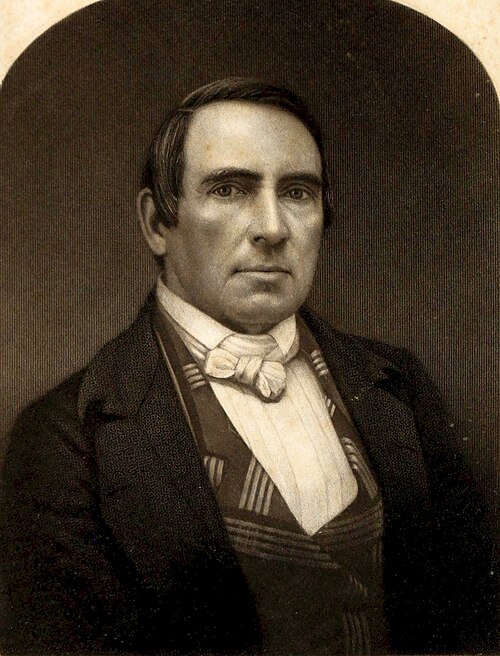
The difficulty of adjustment lay not in the temper or conviction of either government, but in the passionate and very natural excitement of popular feeling in both countries.
James Blaine
The Public Record
James Gillespie Blaine was an American statesman and Republican politician who represented Maine in the United States House of Representatives from 1863 to 1876, served as Speaker of the House from 1869 to 1875, and was a United States senator from 1876 to 1881. He served twice as Secretary of State, under presidents James A. Garfield and Chester A. Arthur in 1881, and under Benjamin Harrison from 1889 to 1892. He sought the Republican presidential nomination in 1876 and 1880, and received the nomination in 1884, narrowly losing the general election to Democratic nominee Grover Cleveland. Blaine was a prominent figure in the moderate faction of the Republican Party, known as the "Half-Breeds".
gutenberg.org
Their avowed object was to obtain the recognition by those governments of the independence of the new Southern Republic, and their success would have been a most dangerous if not a fatal blow to the cause of the Union.
Any reasonable man, looking at the condition of affairs, could not doubt that the public recognition of the independence of the Confederacy by England and France, was a foregone and rapidly approaching conclusion.
It would have been impossible to invent a process more gainful to British commerce, more harmful to American commerce.
It was therefore an invitation, not to a belligerent but to the Southern Confederacy, to accept and thus become a part to an international compact to which in the very nature of things there could be no parties save those whose acceptance…
Events proved that if the English Government had postponed this action until the Government of the United States had been allowed a frank discussion of its policy, no possible injury to English interests could have resulted.
The question therefore was not whether foreign powers had a right to recognize, but whether the time and method of such recognition were not distinctly hostile,-- whether they were not the efficient and coldly calculated means to…
But the recognition of belligerency or independence may be the means to achieve a result, and not simply an impartial acquiescence in a result already achieved.
As the United States had extended its territory, had developed in wealth, had increased in population, richer and richer had become the returns to England's merchants and manufacturers; question after question of angry controversy had been…
When English statesmen were called upon to deal with such a crisis, the United States had a right to expect, if not active sympathy, at least that neutrality which would confine itself within the strict limit of international obligation…
For, treating with all due respect the conviction of the Southern States as to the violation of their constitutional rights, no fair-minded man can deny that the central idea of the secession movement was the establishment of a great…
But the separation of the States was more than the dissolution of the Union.
To destroy their union was to resolve them into worse than colonial disintegration.
This instinct of union had gathered them together as colonies, had formed them into an imperfect confederation, had matured them under a National Constitution.
Whatever might be the complicated relations of their domestic law, to the world and to themselves the United States of America was the indivisible government.
The vital element of that government was Union.
Neither party thoroughly realized the horror of the work before them, though every day made it more clearly apparent.
The fact is worthy of emphasis that since the cordial interchange of notes touching the visit of the Prince of Wales there had not been a single word of unkindness in the correspondence of the two governments.
It is difficult to account for the manifest irritation of its tone except upon the ground that Lord John Russell saw in a possible reconciliation, between North and South, something that threatened the interest or jarred upon the sympathy…
They would warn a government which was making political capital out of blustering demonstrations that our patience might be tried too far.
But they would take care to let the government which multiplied provocations and sought for quarrels understand that their forbearance sprung from the consciousness of strength and not from the timidity of weakness.
Persecution and obloquy have followed him into the grave, but an impartial verdict must be that he was inspired with the devotion of a martyr, and that he wore out his life in a service of priceless value to all the generations of his…
Even his burly frame and rugged strength were overborne by the weight of his cares and by the strain upon his nerves, but not until his work was finished, not until the great salvation had come.
For more than three years, of unceasing and immeasurable responsibility, he stood at his post, by day and by night, never flagging in zeal, never doubting in faith.
To him was committed, in a larger degree than to any other man except the President alone, the successful prosecution of the war and the consequent preservation of the Union.
Politicians like James Blaine