The scheme of invasion rested on the assumption of the dissolution of the Union and its division into two hostile governments; but aside from that possibility, it threatened the United States upon the most vital questions.
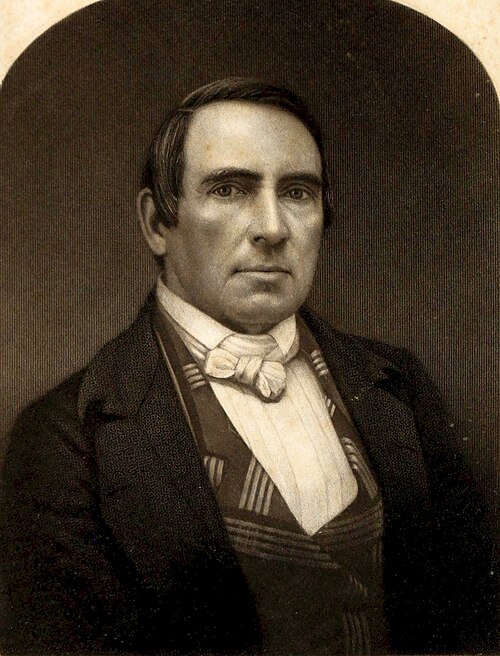
James Blaine
The Public Record
James Gillespie Blaine was an American statesman and Republican politician who represented Maine in the United States House of Representatives from 1863 to 1876, served as Speaker of the House from 1869 to 1875, and was a United States senator from 1876 to 1881. He served twice as Secretary of State, under presidents James A. Garfield and Chester A. Arthur in 1881, and under Benjamin Harrison from 1889 to 1892. He sought the Republican presidential nomination in 1876 and 1880, and received the nomination in 1884, narrowly losing the general election to Democratic nominee Grover Cleveland. Blaine was a prominent figure in the moderate faction of the Republican Party, known as the "Half-Breeds".
gutenberg.org
The success of the establishment of a Foreign Empire in Mexico would have been fatal to all that the United States cherished, to all that it hoped peacefully to achieve.
The colonies of foreign nations following our example became independent republics whose people had the same aspirations, whose governments were framed upon the same basis of popular right.
It was the foundation of a new system both of internal government and foreign relation, a system not entirely isolated from the affairs of the Old World but independent of the dynastic complications and the territorial interests which…
The Declaration of Independence by the British Colonies in America was something more than the creation of a new sovereignty.
It was the spirit of enmity to the Union itself, and the emphatic demonstration of this feeling was the invasion of Mexico for the purpose of converting the republic by force into an empire.
But there was in the foreign policy of Europe towards the United States during the civil war the manifestation of a spirit more intense in its hostility, more dangerous in its consequences.
It creates bitterness; it leads to war; it may in its selfishness cause the destruction of a nation, but it does not necessarily imply a desire for that destruction.
But selfish as is this market-policy, it is a policy of circumstance.
No such absurd system can be found in the principles or precedents of international law; no such system would be permitted by the great powers of Europe if to-morrow they should engage in war.
The new application made the interests of neutral commerce the supreme factor in determining how far belligerent rights should be respected.
Because of the doctrine of belligerent recognition had in its origin referred to nations of well established, independent existence, the doctrine was now pushed forward to the extent of giving ocean belligerency to an insurgent which had…
The truth is that the so-called neutral policy of foreign Powers was the vicious application of obsolete analogies to the conditions of modern life.
If through the necessary employment of all our means of national defense such a partial war shall become a general one between the two nations, the President thinks that the responsibility for that painful result will not fall upon the…
But he is obliged to consider that in the case supposed, the destruction of our commerce will probably amount to a naval war, waged by a portion at least of the British nation against the government and people of the United States--a war…
It was war in disguise --not declared, only because the United-States Government could not afford to multiply its enemies, and England felt that there was still uncertainty enough in the result to caution her against assuming so great a…
Her course, while ingeniously avoiding public responsibility, gave unceasing help to the Confederacy --as effective as if the intention had been proclaimed.
The naked statement of England's position is its worst condemnation.
By these acts the British government gave the most valuable assistance to the South and actually engaged in defeating the military operations of the United States.
And besides it would be impossible to do it with equality: the same things, the like number of troops, the like quantity of arms and munitions furnished under different circumstances are no longer equivalent succors." Assistance is not a…
No neutral has the right to make or accept such an interpolation into the recognized and essential principles of the law of maritime warfare.
Strike the Prize Court out of modern maritime law and the whole system falls, and capture on the sea becomes pure barbarism,--distinguished from piracy only by the astuteness of a legal technicality.
Whenever an insurgent power claims such right, it must be in condition to assume and discharge the obligation which such rights impose.
They were actually giving to the Confederacy a character which it did not possess and which it never acquired.
But when foreign governments recognized in the insurgents the rights of ocean belligerency, they went beyond the fact.
Politicians like James Blaine