Nor is there any disposition among loyal men to stint the praise which is always due to courage.
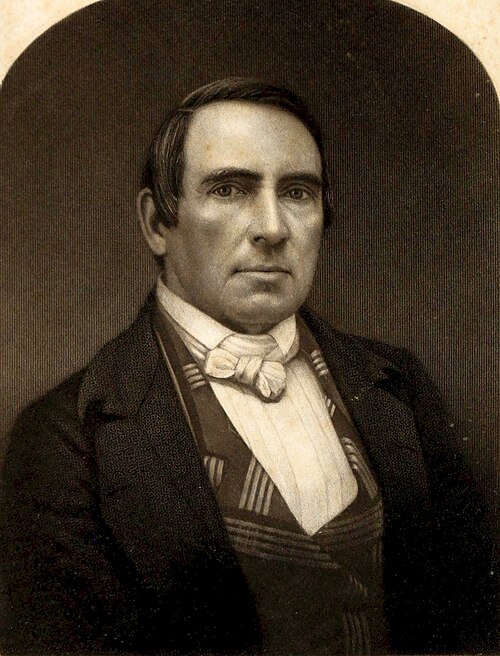
James Blaine
The Public Record
James Gillespie Blaine was an American statesman and Republican politician who represented Maine in the United States House of Representatives from 1863 to 1876, served as Speaker of the House from 1869 to 1875, and was a United States senator from 1876 to 1881. He served twice as Secretary of State, under presidents James A. Garfield and Chester A. Arthur in 1881, and under Benjamin Harrison from 1889 to 1892. He sought the Republican presidential nomination in 1876 and 1880, and received the nomination in 1884, narrowly losing the general election to Democratic nominee Grover Cleveland. Blaine was a prominent figure in the moderate faction of the Republican Party, known as the "Half-Breeds".
gutenberg.org
It would be but poor compliment to the soldiers of the Union to withhold just recognition of the brave opponents who met them on so many hard-fought fields.
The ranks melted away, and there were neither resource nor discipline to fill them again.
The knowledge of the situation had penetrated the ranks, and the men lost spirit and hope.
The forces which Lee and Johnston surrendered contained so many boys unfitted by youth and so many men unfitted by age for military service, that a Northern General epigrammatically remarked that for its armies the Confederacy had been…
It may with reasonable precision be affirmed that the encouragement which the Confederacy received from the slave States that remained true to the Union, was more than offset by the effective aid rendered by loyal men residing within the…
But for the aid thus rendered by the navy, the hard fight would have been longer and more sanguinary.
The establishment and maintenance of a blockade is not accounted by naval officers as the most brilliant service to which in the line of their profession they may be deputed, but it was a service of inestimable value to the cause of the…
The stringency of the blockade which prevented the exportation of cotton, prevented also the importation of manufactured articles.
English manufacturers saw that the supply of the raw product from America could no longer be depended upon, and efforts were made to introduce the manufacture of the inferior staple from India, but the experiment proved in the main…
The demand for food created by the Southern army caused a majority of the plantations to raise corn, and the cotton crop of 1862 did not amount to more than one million bales, very little of which found a foreign market; and the supply and…
As a striking evidence of the prosperity in the South at the time it complained of oppression, the largest cotton crop which had ever been grown was that of 1860.
The natural effect of the war was greatly to lessen production, and the blockade made it impossible to find a market for any large portion of the diminished product of cotton.
The National Government could not permit the export of cotton without constantly aggrandizing the power of the rebellion, and it could not prevent its export without tempting the manufacturing nations of Europe to raise the blockade.
The importance of cotton to the civilized world could hardly be exaggerated, and yet it was this very importance that forced the United States to the course which was pursued.
No Power on earth dares to make war upon cotton.
Standing on this great resolve to accept nothing but Victory or ruin, Victory is ours!
They declared at the ballot-box, by untrammeled popular suffrage, that the war must go on.
It was the free, unbiased, unchangeable will of the Sovereign People.
No imperial power commanded it, no kingly prerogative controlled it.
The one grand feature of this lavish expenditure of wealth by the Government of the United States is that it was directed and enforced by the people themselves.
Our Government was saved by its rigorous system of taxation imposed upon the people by themselves.
The outlay was indeed principally made in paper, but the faith of the United States was given for redemption in coin--a faith which has never been tarnished, and which in this instance has been signally vindicated by the steady…
Throughout the whole period of the war he constantly directed the attention of the nation to dependence on God.
Lincoln had not only full trust in his own capacity, but a deep sense of his own responsibility--a responsibility which could not be transferred and for which he felt answerable to his conscience and to God.
Politicians like James Blaine