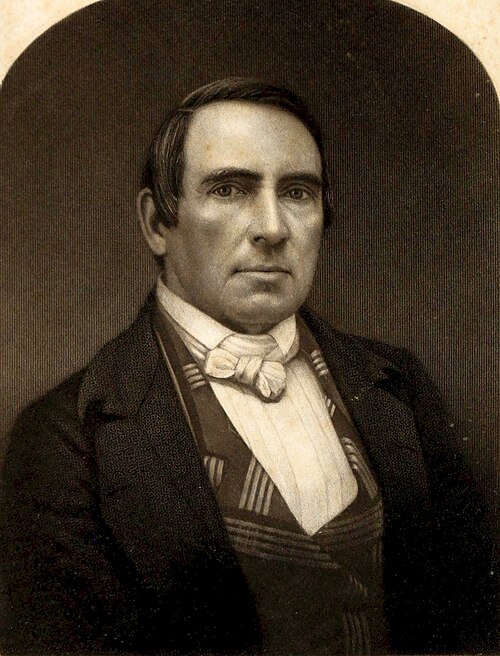
It is indeed the expression of one who realized that he was clothed with all the power belonging to his great office.
James Blaine
The Public Record
James Gillespie Blaine was an American statesman and Republican politician who represented Maine in the United States House of Representatives from 1863 to 1876, served as Speaker of the House from 1869 to 1875, and was a United States senator from 1876 to 1881. He served twice as Secretary of State, under presidents James A. Garfield and Chester A. Arthur in 1881, and under Benjamin Harrison from 1889 to 1892. He sought the Republican presidential nomination in 1876 and 1880, and received the nomination in 1884, narrowly losing the general election to Democratic nominee Grover Cleveland. Blaine was a prominent figure in the moderate faction of the Republican Party, known as the "Half-Breeds".
gutenberg.org
The only art the employed was that of presenting his views so convincingly as to force conviction on the minds of his hearers and his readers.
He sought to control men through their reason and their conscience.
Lincoln's ability was of a far higher and broader character.
As a manager of political issues and master of the art of presenting them, he has had no rival in this country unless one be found in Jefferson.
As a statesman he had the loftiest ideal, and it fell to his lot to inaugurate measures which changed the fate of millions of living men, of tens of millions yet to be born.
He presented an extraordinary combination of mental and moral qualities.
His life was altogether a serious one--inspired by the noblest spirit, devoted to the highest aims.
Appreciating wit and humor, he relished a good story, especially if it illustrated a truth or strengthened an argument, and he had a vast fund of illustrative anecdote which he used with the happiest effect.
Altogether modest, he had confidence in himself, trusted to the reasoning of his own mind, believed in the correctness of his own judgment.
Ready to hear argument and always open to conviction, he adhered tenaciously to the conclusions which he had finally reached.
Lincoln united firmness and gentleness in a singular degree.
Self-control is the first requisite for him who aims to control others.
Courage is as contagious as fear, and General Grant possessed in the highest degree that faculty which is essential to all great commanders,-- the faculty of imparting throughout the rank and file of his army the same determination to win…
Criticism of military skill is but idle chatter in the face of an unbroken career of victory.
He had entered the service with no factitious advantage, and his promotion, from the first to the last, had been based on merit alone,--without the aid of political influence, without the interposition of personal friends.
After nearly four years of a most expensive and wasting war, the means to continue it seem apparently undiminished, while the determination to prosecute it with vigor to the end is unabated.
The people of the United States have felt a just pride in this position before the world.
It has chosen to demonstrate its power to put down insurrection by its own strength, and furnish no pretense for doubt of its entire ability to do so, either to domestic or foreign foes.
He said, "This nation has been able thus far to conduct a domestic war of unparalleled magnitude and cost without appealing for aid to any foreign people.
It is not among the least of the honors belonging to the elder Adams that he gave to the country the illustrious Chief Justice Marshall.
There are single judges in our history who, in point of learning, rank higher in the estimation of the legal profession, but perhaps never a majority of the court who were superior in all the qualities which adorn the Judicial character.
Lincoln's sound judgment was apparent in this as in other great duties.
If they could not participate in the enactment of Statute Law, how could they participate in the far weightier duty of framing the Organic Law of the Republic?
The power of the State was subordinated to the continuing and supreme authority of the Nation.
Politicians like James Blaine