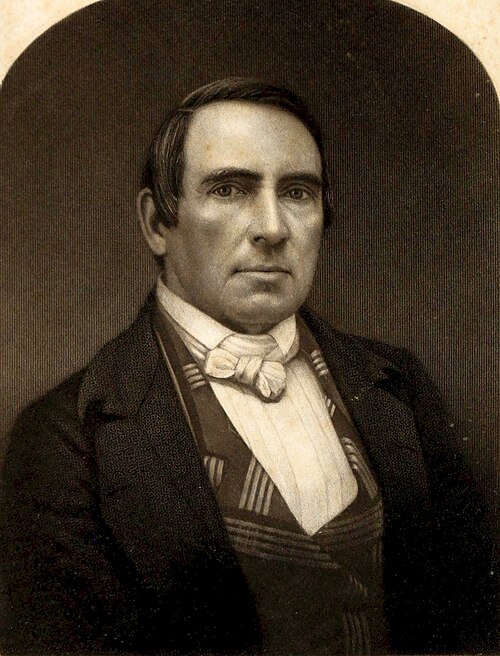
He is the assassin of State rights, the usurper of liberty, and if nominated will be beaten everywhere, as he was at Antietam.
James Blaine
The Public Record
James Gillespie Blaine was an American statesman and Republican politician who represented Maine in the United States House of Representatives from 1863 to 1876, served as Speaker of the House from 1869 to 1875, and was a United States senator from 1876 to 1881. He served twice as Secretary of State, under presidents James A. Garfield and Chester A. Arthur in 1881, and under Benjamin Harrison from 1889 to 1892. He sought the Republican presidential nomination in 1876 and 1880, and received the nomination in 1884, narrowly losing the general election to Democratic nominee Grover Cleveland. Blaine was a prominent figure in the moderate faction of the Republican Party, known as the "Half-Breeds".
gutenberg.org
In advocating an armistice which would involve a practical surrender of the contest he said: "The Administration will not let the shedding of blood cease, even for a little time, to see if Christian charity or the wisdom of statesmanship…
The nomination now of Andrew Johnson from the South tended, in the phrase of the day, to nationalize the Republican party, and this consideration gave it popularity throughout the North.
The vigor and boldness with which, though a Southern senator, he had denounced secession at the beginning of the outbreak, had taken strong hold of the popular heart.
Its commanding feature was its explicit demand for the abolition of slavery.
The wisdom, patriotism, and fidelity of President Lincoln, and his measures for the defense of the nation were approved.
The aggressive qualities of his staunch Scotch ancestry shone in his own resolute and unyielding character, and he was distinguished both in Church and in State as an able and uncompromising controversialist.
His pointed eloquence was equaled by his indomitable courage.
Besides this deepening sentiment of personal devotion and confidence, there was a wide conviction that, in his own expressive phrase, "it is not wise to swap horses while crossing the stream.
The patience, wisdom, and fidelity with which he had guided the government during its unprecedented trials and dangers had won the profound respect and affection of the people.
Lincoln he would retire from the contest, but plainly declared that if the President were renominated there would be no alternative but to organize every element of opposition against him.
Lincoln saw the obvious advantage of placing a man of General Grant's ability in command of all the armies.
The people of this country want a fighting general to lead their armies, and General Grant is the man upon whom we must depend to fight out this rebellion in the end." Mr.
This result forced the question into the Presidential canvass of 1864, and upon the decision of that election depended the question of abolishing slavery.
He contended that the power to amend did not carry with it the power to revolutionize and subvert the form and spirit of the government.
Arnold of Illinois said, "in view of the long catalogue of wrongs which it has inflicted upon the country, I demand to-day the death of African slavery.
He regarded it as the beginning of radical changes in our Constitution, and the forerunner of usurpation.
With the accomplishment of that grand end, said he, "our voices will ascend to Heaven over a country re-united, over a people disinthralled, and God will bless us.
Ingersoll of Illinois made a strong and eloquent appeal for the passage of the amendment and the liberation of the slave.
He charged the war and all its manifold horrors upon the system of slavery.
Davis betrayed by this motion his apprehension that freedom to the negro would be followed by the enjoyment of civil rights and the exercise of political power.
Ashley of Ohio is entitled to the credit of having made the first proposition to Congress to amend the Constitution so as to prohibit slavery throughout the United States.
No servile insurrection or tendency to cruelty has marked the measures of emancipation and the arming of the blacks. . . .
Full one hundred thousand of them are now in the United-States military service, about one-half of which number actually bear arms in the ranks, thus giving a double advantage,--of taking so much labor from the insurgents' cause, and…
Tennessee and Arkansas have been substantially cleared of insurgent control, and influential citizens in each,--owners of slaves and advocates of slavery at the beginning of the Rebellion,--now declare openly for emancipation in their…
Politicians like James Blaine