Our commerce was suffering greatly by a few armed vessels built upon and furnished from foreign shores, and we were threatened with such additions from the same quarter as would sweep our trade from the sea and raise the blockade.
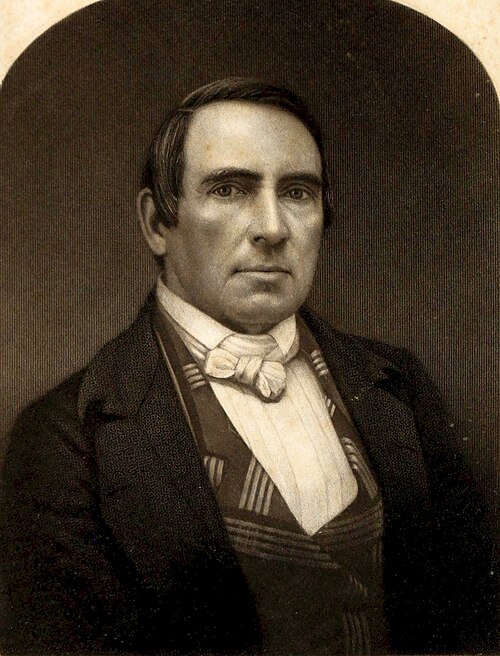
James Blaine
The Public Record
James Gillespie Blaine was an American statesman and Republican politician who represented Maine in the United States House of Representatives from 1863 to 1876, served as Speaker of the House from 1869 to 1875, and was a United States senator from 1876 to 1881. He served twice as Secretary of State, under presidents James A. Garfield and Chester A. Arthur in 1881, and under Benjamin Harrison from 1889 to 1892. He sought the Republican presidential nomination in 1876 and 1880, and received the nomination in 1884, narrowly losing the general election to Democratic nominee Grover Cleveland. Blaine was a prominent figure in the moderate faction of the Republican Party, known as the "Half-Breeds".
gutenberg.org
The compactness and clearness of his statement, the facts and arguments which he could marshal in that brief time, were a constant surprise and delight to his hearers.
His perceptions were keen, his analysis was extraordinarily rapid, his power of expression remarkable.
He made elaborate preparation by the study of all public questions, and spoke from a full mind with complete command of premise and conclusion.
He had no boastful reliance upon intuition or inspiration or the spur of the moment, though no man excelled him in extempore speech.
Heart and spirit were given to the people, hope grew into confidence, the strength of the Government was vastly increased, the prestige of the Administration was greatly heightened.
The numbers on each side differed but little from the numbers engaged at Waterloo, and the tenacity with which the soldiers of the British Isles stood that day against the hosts of Napoleon, was rivaled on the field of Gettysburg by men of…
The tide of invasion had been rolled back after the bloodiest and most stubbornly contested field of the war.
With men of the North the struggle was now for home first, for conquest afterwards, and the tenacity and courage with which they held their ground for those three bloody days attest the magnificent impulse which the defense of the fireside…
The indispensable requisite to Union success was a commander for the Army of the Potomac in whose competency the Administration, the people, and most of all the soldiers would have confidence.
He had a genius for war, and in a purely military point of view it would perhaps have been better for the Confederates to lose the battle than to lose the most aggressive officer in their Army.
Must I shoot a simple-minded soldier-boy who deserts, while I must not touch a hair of the wily agitator who induces him to desert?
Long experience has shown that armies cannot be maintained unless desertion shall be punished by the severe penalty of death.
I understand the meeting whose resolutions I am considering, to be in favor of suppressing the Rebellion by military force--by armies.
The evil effect upon the public opinion of the North of such language from a man of Governor Seymour's high personal character and commanding influence with his party can hardly be exaggerated.
The action of the Administration will determine, in the minds of more than one-half of the people of the Loyal States, whether this war is waged to put down rebellion in the South or to destroy free institutions at the North.
Having given it a generous support in the conduct of the war, we now pause to see what kind of government it is for which we are asked to pour out our blood and our treasure.
If this proceeding is approved by the government and sanctioned by the people it is not merely a step towards revolution, it is revolution; it will not only lead to military despotism, it establishes military despotism.
The judge declared that the power of the President undoubtedly implies the right to arrest persons who by their mischievous acts of disloyalty impede or hinder the military operations of the government.
Lincoln saw plainly that the Administration was not equal to the task of subduing two rebellions.
They are current in almost every part of the American continent, and are readily exchangeable for coin in all the marts of Europe.
In no other system of banking have the bills had such wide circulation and such absolute credit.
But so long as a National debt exists no use has been found for it more conducive to the general prosperity than making it the basis of a banking system in which flexibility and safety are combined to a degree never before enjoyed in this…
In a Republican government the people naturally oppose a perpetual debt, and could with difficulty be persuaded to consent to it for any incidental purpose however desirable.
The one defective element in the National bank system is that it requires the permanence of National debt as the basis of its existence.
Politicians like James Blaine