In the case of the National Bank, the government holds the security in its own hands and protects the public from the possibility of loss.
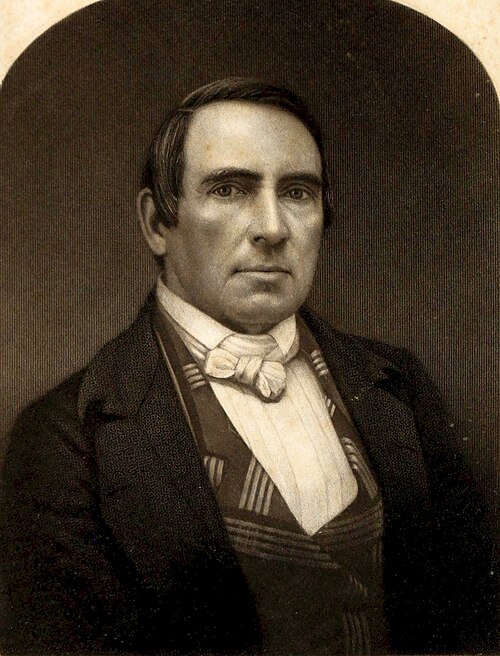
James Blaine
The Public Record
James Gillespie Blaine was an American statesman and Republican politician who represented Maine in the United States House of Representatives from 1863 to 1876, served as Speaker of the House from 1869 to 1875, and was a United States senator from 1876 to 1881. He served twice as Secretary of State, under presidents James A. Garfield and Chester A. Arthur in 1881, and under Benjamin Harrison from 1889 to 1892. He sought the Republican presidential nomination in 1876 and 1880, and received the nomination in 1884, narrowly losing the general election to Democratic nominee Grover Cleveland. Blaine was a prominent figure in the moderate faction of the Republican Party, known as the "Half-Breeds".
gutenberg.org
In the former case there was no protection to the people who trusted the bank by taking its bills.
In the present system the National Bank deposits its bonds with the Treasury Department, where they are held as special security for the redemption of the bills which the bank puts in circulation.
He saw that such an institution increasing with the growth of the country would surely lead to corruption, and by its unlimited power would interfere with the independence of Congress and with the just liberty of the people.
It is the contemplation of such an enormous power placed in the hands of any body of men that gives a more correct appreciation of the conduct and motives of General Jackson in his determined contest with the United-States Bank.
It is hardly conceivable that such a power as this could ever be intrusted to the management of a Secretary of the Treasury or to a single board of directors, with the temptations which would beset them.
If a similar institution were established to-day, bearing a like proportion to the wealth of the country, it would require a capital of at least six hundred millions of dollars--many fold larger than the combined wealth of the Bank of…
The division and distribution of bank capital under the National system do not merely carry its advantages to every community, but they afford the most complete guaranty against every abuse which may spring from a large aggregation of…
The misfortunes which had come upon the United-States Bank from its connection with party interests were fully appreciated by the wise legislators who drafted the National Bank Act.
Political friends of the institution were too often accommodated on easy terms, and legitimate banking was thus rendered impossible.
An especially odious feature in the United-States Bank was the favoritism shown in its loans, by which it constantly tended to debauch the public service.
The war of 1812 followed, and in the sweep of its disastrous influence a large majority of these banks were destroyed, their notes never redeemed, and great distress consequently inflicted upon the people.
Indeed the methods of banking--it might be proper to say its secrets--were jealously guarded by the capitalists who monopolized it in the financial centres of Europe.
The most important financial institution established in the United States before the adoption of the Constitution was the Bank of North America, still doing business in Philadelphia, with unbroken career through all the mutations of the…
The Bank of the United States, as twice established, incurred the hostility of the Democratic party,--their two greatest leaders, Jefferson and Jackson, regarding the creation of such an institution as not warranted by the Constitution.
The restoration of the multiform State system, with notes of varying value and banks of doubtful solvency, would receive no support among the people.
The advantages of uniform circulation on a basis of undoubted strength and availability have won almost universal favor among business men and prudent thinkers.
Experience has justified the authors and promoters of the national banking system.
Its success thus far had demonstrated that under a perfected law it would soon become the general and popular banking system of the country.
If we permit these banks to flood the channels of circulation, we destroy ourselves.
If the government goes down, there is not a considerable bank in America that does not go down with it.
The government would thus be largely benefitted, and its cause would be strengthened by the silent influence of self-interest which would certainly be developed by the general distribution of its bonds as the basis of a national currency.
Under the influences thus at work, the friends of the State banks plainly saw that the National system was growing in favor, and they began to admit that its creation might facilitate the financial operations of the country.
No provision of law could have operated so powerfully for a system of National banks.
If the States would not surrender their prerogative, the National Government would be compelled to exercise its larger prerogative embodied in the power to tax.
Politicians like James Blaine