Common justice revolts at the selection of one man for punishment from eleven who have all been guilty of the same offense.
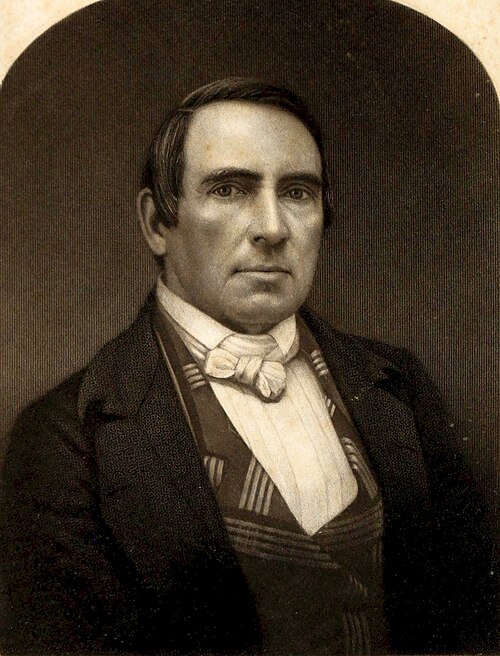
James Blaine
The Public Record
James Gillespie Blaine was an American statesman and Republican politician who represented Maine in the United States House of Representatives from 1863 to 1876, served as Speaker of the House from 1869 to 1875, and was a United States senator from 1876 to 1881. He served twice as Secretary of State, under presidents James A. Garfield and Chester A. Arthur in 1881, and under Benjamin Harrison from 1889 to 1892. He sought the Republican presidential nomination in 1876 and 1880, and received the nomination in 1884, narrowly losing the general election to Democratic nominee Grover Cleveland. Blaine was a prominent figure in the moderate faction of the Republican Party, known as the "Half-Breeds".
gutenberg.org
Assuredly there was no ground for distressing Virginia by penal enactments that did not apply equally to every other State of the Confederacy.
Do not break up the rich cluster of glorious memories and associations which gather over the name and the history of this ancient and once glorious Commonwealth.
Let there not be two Virginias; let us remain one and united.
I will not stultify myself by supposing that we have any warrant in the Constitution for this proceeding.
I shall vote for this bill upon that theory, and upon that alone.
We may admit West Virginia as a new State, not by virtue of any provision of the Constitution but under our absolute power which the laws of war give us in the circumstances in which we are placed.
None of the States now in rebellion are entitled to the protection of the Constitution.
But according to my principles operating at the present time I can vote for the admission of West Virginia without any compunctions of conscience--only with some doubt about the policy of it.
The State, as a separate distinct body, is the State of a majority of the people of Virginia, whether rebel or loyal, whether convict or free men.
If the remaining portions of Virginia are under duress while this consent is given, it is a mere mockery of the Constitution." Mr.
The question here is which shall the Government of the United States recognize as the true and lawful Legislature of Virginia?" He contended that it had already been settled, by the admission of members of both branches of Congress under…
The Constitution gives us no power to do what we are asked to do." Mr.
This would be "a new-made Union--the old majestic body cut and slashed by passion, by war, coming to form another government, another Union.
He argued that West Virginia had taken every step regularly and complied with every requirement of the Constitution.
They believed that the convictions of the people of West Virginia had developed to the point embodied in the bill, and that to attempt the immediate extirpation of slavery might lead to re-action and possibly to the rejection of the…
But now, by the chances of war, the same men who desired to create the new State were wielding the entire political power of Virginia, and they would naturally grant permission to themselves to erect a State that would be entirely free…
They enjoyed a climate as genial as that of the Italians who dwell on the slopes of the Apennines; they had forests more valuable than those that skirt the upper Rhine; they had mineral wealth as great as that which has given England her…
The West-Virginians were aware of the splendid resources of their section and were constantly irritated by the neglect of the parent State to aid in their development.
Their prompt and intelligent action is a remarkable illustration of the trained and disciplined ability of Americans for the duties of self-government.
They realized that with the secession of Virginia, completed and proclaimed, they must do one of two things--either proceed at once to organize a State government which would be faithful to the National Constitution, or drift helplessly…
What the President desired was the establishment of civil government by a loyal people, with the reign of law and order everywhere recognized.
The spirit with which the President and Congress proceeded in that depressing and depressed period proved invaluable to the country.
The measure had long been demanded by the aggressive sentiment of the North, and its enactment was hailed by the mass of people in the Loyal States as a great step forward.
It was a policy that required great moral courage, and it was abundantly rewarded by successful results.
Politicians like James Blaine