But every step she took in the development of her steam marine by the payment of bounty, was in flat contradiction of the creed which she was at the same time advocating in those departments of trade where she could conquer her competitors…
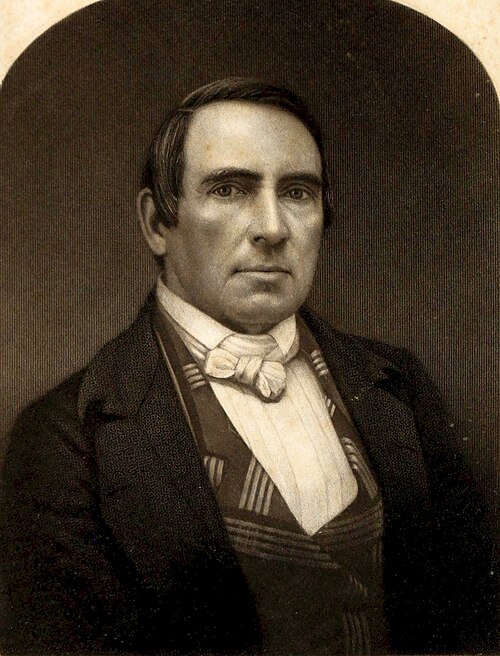
James Blaine
The Public Record
James Gillespie Blaine was an American statesman and Republican politician who represented Maine in the United States House of Representatives from 1863 to 1876, served as Speaker of the House from 1869 to 1875, and was a United States senator from 1876 to 1881. He served twice as Secretary of State, under presidents James A. Garfield and Chester A. Arthur in 1881, and under Benjamin Harrison from 1889 to 1892. He sought the Republican presidential nomination in 1876 and 1880, and received the nomination in 1884, narrowly losing the general election to Democratic nominee Grover Cleveland. Blaine was a prominent figure in the moderate faction of the Republican Party, known as the "Half-Breeds".
gutenberg.org
In all channels of trade where steam could be employed she paid lavish subsidies, and literally destroyed fair competition, and created for herself a practical monopoly in the building of iron steamers, and a superior share in the ocean…
To a single line of steamers running alternate weeks from Liverpool to Boston and New York, she paid nine hundred thousand dollars annually, and continued to pay at this extravagant rate for at least twenty years.
She did not wait for her own theory of Free-trade to work out its legitimate results, but forthwith stimulated the growth of her steam marine by the most enormous bounties ever paid by any nation to any enterprise.
She could build engines at less cost than we, and when, soon afterward, her ship-builders began to construct the entire steamer of iron, her advantages became evident to the whole world.
She had nothing to fear from the United States in the domain of manufacturers, and she therefore asked us to give her the unrestricted benefit of our markets in exchange for a similar privilege which she offered to us in her markets.
Long after the triumph of free-trade in manufactures, as proclaimed in 1846, England continued to violate every principle of her own creed in the protection she extended to her navigation interests.
She did not apply it to all departments of her enterprise, but only to those in which she felt confident that she could defy competition.
England was however neither consistent nor candid in her advocacy and establishment of free-trade.
England came to this policy after having clogged and embarrassed trade for a long period by the most unreasonable and tyrannical restrictions, ruthlessly enforced, without regard to the interests or even the rights of others.
As contradistinguished from the theory of protection, England has realized freedom of trade by taxing only that class of imports which meet no competition in home production, thus excluding all pretense of favor or advantage to any of her…
It had obtained a stronger hold on the Republican party than even the leaders of that organization were aware, and it was destined to a larger influence upon popular opinion than the most sagacious could foresee.
The tariff therefore had a controlling influence not only in deciding the contest for political supremacy but in that more momentous struggle which was to involve the fate of the Union.
In reviewing the agencies therefore which precipitated the political revolution of 1860, large consideration must be given to the influence of the movement for Protection.
Lincoln's election, and that very fact added immeasurably to his popular strength in the closing month of the prolonged and exciting struggle.
Whichever party carried it was sure, in the popular judgment, to elect the President.
The October election of Pennsylvania was for so long a period an unerring index to the result of the contest for the Presidency, that a feeling almost akin to superstition was connected with it.
If Governor Curtin could have presented no other issue to the voters of Pennsylvania, he would undoubtedly have shared the fate which Wilmot met when he had these anti-slavery questions as his only platform.
Curtin, when he was chosen governor by a majority of thirty-two thousand, was largely due to his able and persuasive presentation of the tariff question, and to his effective appeals to the laboring- men in the coal and iron sections of…
On the other issues of the party they had been hopelessly beaten, but the moment the hostility to slave-labor in the Territories became identified with protected labor in Pennsylvania, the party was inspired with new hopes, received indeed…
The promises of Democratic leaders had failed, their predictions had been falsified, and as a consequence their strength was shattered.
With a tariff of their own making, with a President of their own choice, with both branches of Congress and every department of the government under their control, a serious disaster had come upon the country.
The tariff of 1846 therefore under which there had been a very high degree of prosperity, was, in the judgment of the protectionists, successfully impeached, and a profound impression in consequence made on the public mind in favor of…
The free-traders, as an answer to this arraignment of their tariff policy, seek to charge responsibility for the financial disasters to the hasty and inconsiderate changes made in the tariff in 1857, for which both parties were in large…
The protectionists therefore hold that the boasted prosperity of the country under the tariff of 1846 was abnormal in origin and in character.
Politicians like James Blaine