No threat of its destruction ever came from her councils, and no stress of circumstances could ever seduce her into a calculation of its value, or drive her to the contemplation of its end.
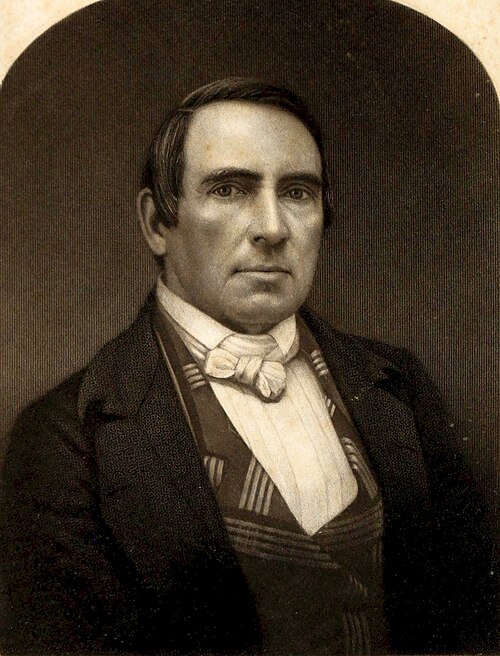
James Blaine
The Public Record
James Gillespie Blaine was an American statesman and Republican politician who represented Maine in the United States House of Representatives from 1863 to 1876, served as Speaker of the House from 1869 to 1875, and was a United States senator from 1876 to 1881. He served twice as Secretary of State, under presidents James A. Garfield and Chester A. Arthur in 1881, and under Benjamin Harrison from 1889 to 1892. He sought the Republican presidential nomination in 1876 and 1880, and received the nomination in 1884, narrowly losing the general election to Democratic nominee Grover Cleveland. Blaine was a prominent figure in the moderate faction of the Republican Party, known as the "Half-Breeds".
gutenberg.org
From geographical position therefore, from material interest, from inherited pride, from every association and sympathy, from every aspiration, and from every hope, Pennsylvania was for the Union, inviolable and indissoluble.
It was on her soil that the Declaration of Independence was proclaimed.
In the original Union, Pennsylvania was appropriated denominated the Keystone of the arch, supported by, and in turn supporting, the strength of all.
It devolved on him to arrest the mad outbreak of the South by judicious firmness, or by irresolution and timidity to plunge the Nation into dangers and horrors, the extent of which was mercifully veiled from the vision of those who were to…
The administration could adopt no policy so dangerous as to permit the enemies of the Union to proceed in their conspiracy, and the hostile movement to gain perilous headway.
The Disunion conspiracy had reached a point where it must go forward with boldness, or retreat before the displayed power and the uplifted flag of the Nation.
Stephens, while he was still loyal, was almost strong enough to hold the State in the Union; and but for the phantasm of securing better terms outside, the Empire State of the South would have checked and destroyed the Secession movement…
Georgia was really induced to secede, only upon the delusive suggestion that better terms could be made with the National Government by going out for a season than by remaining steadfastly loyal.
The South had always contended for the right of States to instruct their senators, but now the Southern senators proceeded to instruct their States.
Mirabeau said that words were things; and this word was so used in the proceedings of Secession conventions as to impress the mind of the Southern people with its portentous weight and solemnity.
One of the members declared that if South Carolina again waited for co-operation, slavery and State-rights would be abandoned, State-sovereignty and the cause of the South would be lost forever.
The few who were left in possession of coolness and sound judgment among the public men of South Carolina, desired to stay the rush of events by waiting for co-operation with the other slave-holding States.
They knew that the feeling of resentment among the Southern people must be kept at white-heat, and that whoever wished to speak a word of caution or moderation must be held as a public enemy, and subjected to the scorn and the vengeance of…
The leaders of it knew that the sober second thought, even in South Carolina, would be dangerous to the scheme of a Southern confederacy.
In a single hour they created in their own State a public sentiment which would not brook delay or contradiction or argument.
Without taking time for reflection, without a review of the situation, without stopping to count the cost, with a boldness born of passionate resentment against the North, the rash men of South Carolina fired the train.
Indeed, it is scarcely an exaggeration to say that the great civil war, which shook a continent, was precipitated by the fact that the South-Carolina Legislature assembled at the unpropitious moment.
While it might seem extravagant to ascribe the revolution which convulsed the country to an event so disconnected and apparently so inadequate, it is nevertheless true that the sudden furor which seized a large number of the Southern…
Those who used it as a political engine for the consolidation of political power had views and ambitions inconsistent with the plans and hopes of law-abiding citizens.
Those who viewed it and used it merely as a system of labor, naturally desired peace and dreaded commotion.
But slavery as an economical institution and slavery as a political force were quite distinct.
Indeed, it was a sense of strength born of exceptional prosperity which led them to their rash adventure of war.
There was never a community of the face of the globe whose condition so little justified revolution as that of the slave States in the year 1860.
In the whole history of the American people, there is no epoch which recalls so much that is worthy of regret and so little that gratifies pride.
Politicians like James Blaine