It is not strange that, with this vast enginery, the power to produce has a constant tendency to outrun the power to consume.
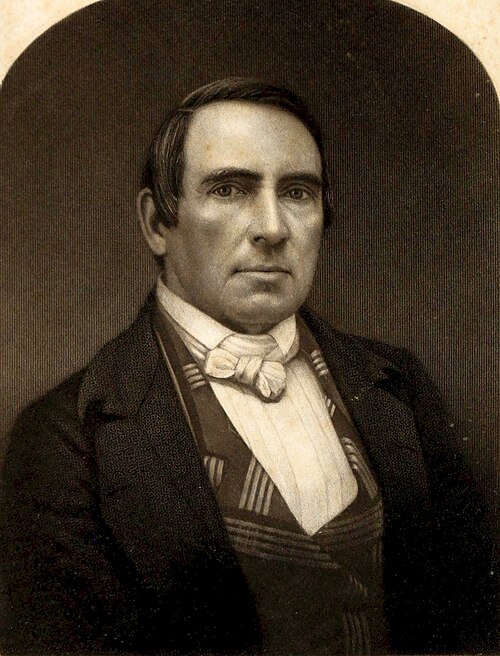
James Blaine
The Public Record
James Gillespie Blaine was an American statesman and Republican politician who represented Maine in the United States House of Representatives from 1863 to 1876, served as Speaker of the House from 1869 to 1875, and was a United States senator from 1876 to 1881. He served twice as Secretary of State, under presidents James A. Garfield and Chester A. Arthur in 1881, and under Benjamin Harrison from 1889 to 1892. He sought the Republican presidential nomination in 1876 and 1880, and received the nomination in 1884, narrowly losing the general election to Democratic nominee Grover Cleveland. Blaine was a prominent figure in the moderate faction of the Republican Party, known as the "Half-Breeds".
gutenberg.org
It is asserted by an intelligent economist that, if performed by hand, the work done by machinery in Great Britain would require the labor of seven hundred millions of men,--a far larger number of adults than inhabit the globe.
No cause is more potent than the prodigious capacity of machinery set in motion by the agency of steam.
They maintain however that by the influence of a protective tariff the crisis was long postponed; that under the reign of free-trade it would have promptly followed the return of peace when the country was ill able to endure it.
They direct further attention to the complementary fact that, in each of these cases, financial prosperity was regained through the agency of a protective tariff, the operation of which was prompt and beneficent.
They aver indeed that a glut of manufactured articles is more frequently seen in England than in the United States, thus proving directly the reverse of the conclusion assumed by the free-traders, and establishing the conservative and…
An argument much relied upon and strongly presented by the advocates of free-trade is the alleged tendency to over-production of protected articles, followed uniformly by seasons of depression and at certain intervals by financial panic…
Hamilton, does not invite competition from abroad, but is based on the controlling principle that competition at home will always prevent monopoly on the part of the capitalist, assure good wages to the laborer, and defend the consumer…
If the duty be adjusted on that basis for any given date, a reduction of wages would at once be enforced abroad, and the American manufacturer would in consequence be driven to the desperate choice of surrendering the home market or…
Free-traders have at times attempted to deny the truth of the statement; but every impartial investigation thus far has conclusively proved that labor is better paid, and the average condition of the laboring man more comfortable, in the…
On this point protectionists are more frank than their opponents; they realize that it constitutes indeed the most impregnable defense of their school.
Free-traders do not, and apparently dare not, face the plain truth--which is that the lowest priced fabric means the lowest priced labor.
The difference is due in large degree to the wages paid to labor, and thus the question of reducing the tariff carries with it the very serious problem of a reduction in the pay of the artisan and the operative.
He gives numerous illustrations of articles which under the influence of home competition have fallen in price below the point at which the foreign article was furnished when there was no protection.
If the duty be so arranged as to produce the greatest amount of revenue, it must be placed at that point where the foreign article is able to undersell the domestic article and thus command the market to the exclusion of competition.
The essential question which has grown up between political parties in the United States respecting our foreign trade, is whether a duty should be laid upon any import for the direct object of protecting and encouraging the manufacture of…
It is the enjoyment of free-trade and protection at the same time which has contributed to the unexampled development and marvelous prosperity of the United States.
Fifty-five millions of American people (in 1884), over an area nearly as large as the entire continent of Europe, carry on their exchanges by ocean, by lake, by river, by rail, without the exactions of the tax-gatherer, without the…
The effect of these provisions was to insure to the United States a freedom of trade beyond that enjoyed by any other nation.
At the same time trade was left absolutely free between all the States of the Union, no one of them being permitted to levy any tax on exports or imports beyond what might be necessary for its inspection laws.
They now had the opportunity, as citizens of a free Republic, to show the generous breadth of their statesmanship, and they did so by providing in their Constitution, that Congress should never possess the power to levy "a tax or duty on…
The colonists had experienced the oppression of the English laws which prohibited export from the mother country of the very articles which might advance their material interest and improve their social condition.
The new government was indeed as far in advance of European nations in the proper conception of liberal commerce as it was on questions relating to the character of the African slave-trade.
The trade policy of the United States at the foundation of the government had features of enlightened liberality which were unknown in any other country of the world.
They have each in turn regulated the adoption of free-trade by the ratio of their progress towards the point where they could overcome competition.
Politicians like James Blaine