The farmers and planters at no other period of our history were in receipt of such good prices, steadily paid to them in gold coin, for their surplus product, which they could send to the domestic market over our own railways and to the…
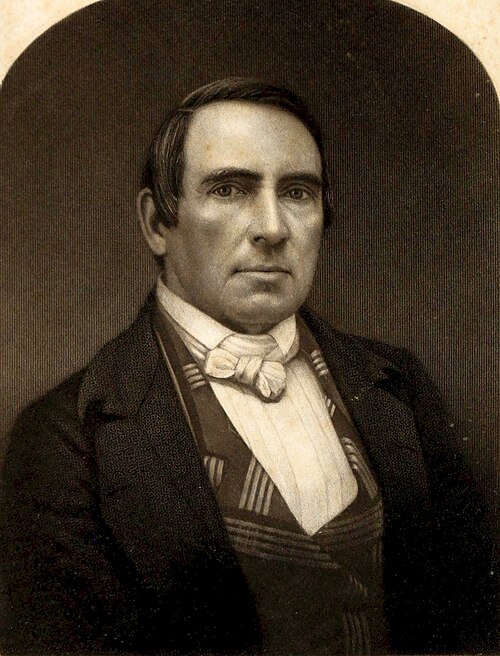
James Blaine
The Public Record
James Gillespie Blaine was an American statesman and Republican politician who represented Maine in the United States House of Representatives from 1863 to 1876, served as Speaker of the House from 1869 to 1875, and was a United States senator from 1876 to 1881. He served twice as Secretary of State, under presidents James A. Garfield and Chester A. Arthur in 1881, and under Benjamin Harrison from 1889 to 1892. He sought the Republican presidential nomination in 1876 and 1880, and received the nomination in 1884, narrowly losing the general election to Democratic nominee Grover Cleveland. Blaine was a prominent figure in the moderate faction of the Republican Party, known as the "Half-Breeds".
gutenberg.org
The awakening of all branches of industry by that Act was further promoted by the tariff of 1828, to which the protectionists point as the perfected wisdom of their school.
The country did not revive, or prosperity re-appear, until the protective tariff of 1824 was enacted.
The difficulty in reaching a satisfactory and impartial conclusion arises from the inability or unwillingness of the disputants to agree upon a common basis of fact.
But as a whole, the record of tariff legislation, from the very origin of the government, is the record of enlightened selfishness; and enlightened selfishness is the basis of much that is wisest in legislation.
From that hour the Republican party gravitated steadily and rapidly into the position of avowed advocacy of the doctrine of protection.
This phase of the question was presented with great force in certain States, and the industrial classes, by a sort of instinct of self- preservation as it seemed to them, began to consolidate their votes in favor of the Republican party.
The country was not exhausted and depleted as it was after the panic of 1837, but the business community had no courage, energy was paralyzed, and new enterprises were at a stand-still.
In the autumn of 1857, half a year after the passage of the tariff Act, a disastrous financial panic swept over the country, prostrating for the time all departments of business in about the same degree.
This singular coalition portended one of two results: Either an entire and permanent acquiescence in the rule of free-trade, or an entire abrogation of that system, and the revival, with renewed strength, of the doctrine of protection.
The principles embodied in the tariff of 1846 seemed for the time to be so entirely vindicated and approved that resistance to it ceased, not only among the people but among the protective economists, and even among the manufacturers to a…
He resisted the passage of the tariff of 1846, stood firmly and consistently for the industrial interests of his State, cultivated an alliance with the Whigs in the Senate, and by their aid thwarted all the attempts of the Polk…
But he was a believer in the doctrine of protection; and as he had aided in carrying Pennsylvania by declaring himself a friend to the tariff of 1842, he maintained his faith.
He was not a believer in the doctrine of protection, was persuaded that protective duties bore unjustly and severely upon the planting section with which he was identified; and he came to his office determined to overthrow the tariff Act…
It imparted to all sections a degree of prosperity which they had not known since the repeal of the tariff of 1828.
It raised the country from a slough of despond to happiness, cheerfulness, confidence.
The friends of home industry have always referred with satisfaction to the effect of the tariff of 1842 as an explicit and undeniable proof of the value of protection.
The vote showed, as all tariff bills before had, and as all since have shown, that the local interest of the constituency determines in large measure the vote of the representative; that planting sections grow more and more towards…
There was a general feeling that the Act of 1828 marked a crisis in the history of tariff discussion, and that it would in some way lead to important results in the fate of political parties and political leaders.
They applied the doctrine of protection to the raw materials of the country, the wool, the hemp, and all unmanufactured articles which by any possibility could meet with damaging competition from abroad.
The effect of that tariff was undoubtedly favorable to the general prosperity, and during the administration of John Quincy Adams every material interest of the country improved.
The farmer will find a ready market for his surplus products, and, what is almost of equal consequence, a certain and cheap supply for all his wants.
When our manufactures are grown to a certain perfection, as they soon will be under the fostering care of the government, we shall no longer experience these evils.
He believed that the vital deficiency in our financial condition was the lack of manufactures, and to supply that deficiency he was willing to extend the protecting arm of the government.
With all the disadvantages which so sudden and so extreme a policy imposed on the people, the progress for the four years of these extravagant and exceptional duties was very rapid, and undoubtedly exerted a lasting influence on the…
Politicians like James Blaine