That the same policy and drill, invigorated by success and fortified by experience, has now placed Martin Van Buren in the President's chair, and disclosed to the unprincipled ambition of the North the art of rising upon the principles of…
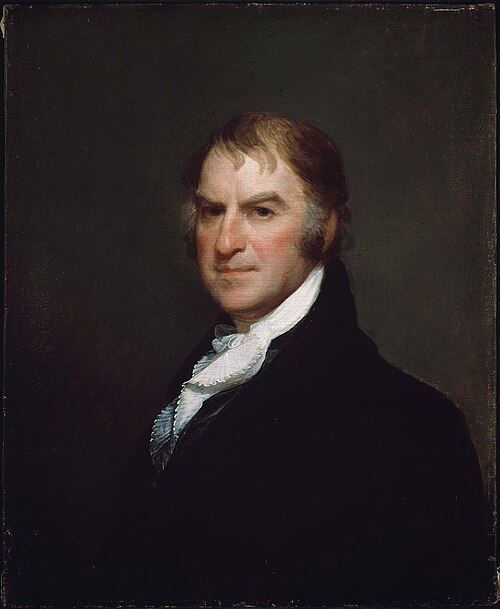
Josiah Quincy
The Public Record
Josiah Quincy III was an American educator and political figure. He was a member of the U.S. House of Representatives (1805–1813), mayor of Boston (1823–1828), and President of Harvard University (1829–1845). The historic Quincy Market in downtown Boston is named in his honor. A panel of 69 scholars in 1993 ranked him among the ten best mayors in American history.
gutenberg.org
That this policy and drill, first organized by Thomas Jefferson, accomplished his election, and established the Virginia dynasty of twenty-four years;--a perpetual practical contradiction of its own principles. 5th.
That, in the absence of military service, demagogue policy is the first and most indispensable element of success, and the art of party drilling the second. 3d.
That the direct and infallible path to the Presidency is military service, coupled with demagogue policy. 2d.
Again, in October ensuing: "One of the peculiarities of the present time is that the principal leaders of the political parties are travelling about the country from state to state, and holding forth, like Methodist preachers, to assembled…
The tendency of all this is to the corruption of popular elections both by violence and fraud.
Adams remarked, on the electioneering addresses then made, preparatory to the next election of President: "This practice of itinerant speech-making has suddenly broken out in this country to a fearful extent.
Slavery, the Indians, the public lands, the collection and disbursement of public moneys, the tariff, and foreign affairs--what is to become of them?
The continuance of the present administration will, if accomplished, open wide all the floodgates of corruption.
I have seen this before; but the worst symptom now is the change in the manners of the people.
Adams thus expressed his opinion of the state of public affairs: "The late session of Congress has been painful to me beyond all former experience, by the demonstration it has given of degenerating institutions.
Long enough have the leagues and federations between the potentates of the earth been confined to alliances, offensive and defensive, to promote purposes of mutual hatred and hostility.
The committee would hail, with feelings of hope and encouragement, the virtual alliance of great and mighty nations for this union of efforts in the promotion of the cause of science.
There is a feeling, but too prevalent, which distinguishes between custom-house oaths and other oaths.
If an English merchant, subscribing to this principle, goes to establish himself in a foreign country, he goes as an enemy, warranted, by the sanction of his own courts and Parliament, to do anything that can defraud its revenue.
When a principle like this goes out, sanctioned with the legislative authority, it will have its effect on the nation.
What can it be but to encourage frauds on the revenue of other nations?
What is the natural effect of the promulgation of such principles by such authority?
The object was that smugglers should not only escape the effect of their villany, but should be actually encouraged by government in its perpetration.
Judge Buller heard Lord Mansfield say that the object of the exception in regard to Spain and Portugal was to encourage--yes, to encourage--the smuggling trade.
He was the first British judge who established the principle that it is a lawful thing for Englishmen to cheat the revenue laws of other nations, especially those of Spain and Portugal.
In some respects it has been greatly to the advantage of those laws, but in others as much to their disadvantage and discredit, of which the maxim of which I now speak is a signal instance.
The author of the maxim was a man famous throughout the civilized world,--a man of transcendent talents, who fixed, more, perhaps, than any other man of the same century, his impress on the age in which he lived, and upon the laws of…
It is a maxim of British commercial law that it is lawful for the citizens of one nation to defraud the revenues of other nations.
The influence of all these discoveries upon the condition of man is no doubt infinitely diversified in relative importance; but all, even the minutest, contribute to the increase and diffusion of knowledge.
Politicians like Josiah Quincy