Adams deemed and maintained, was unconstitutional; and he called upon the supporters of the bill to point out the article, section, or paragraph, of the constitution, which authorized Congress to confer it on the President.
Josiah Quincy
The Public Record
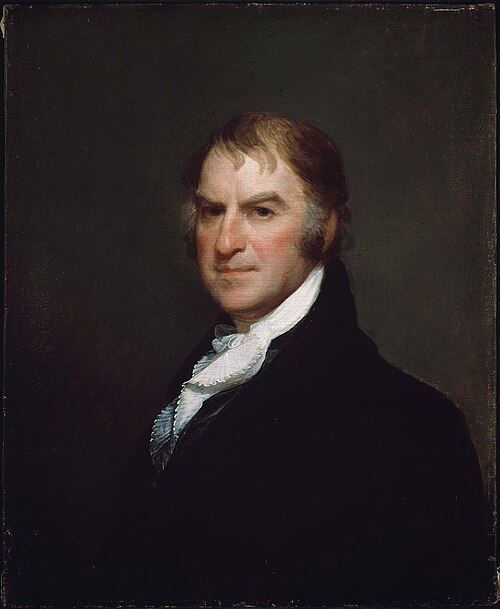
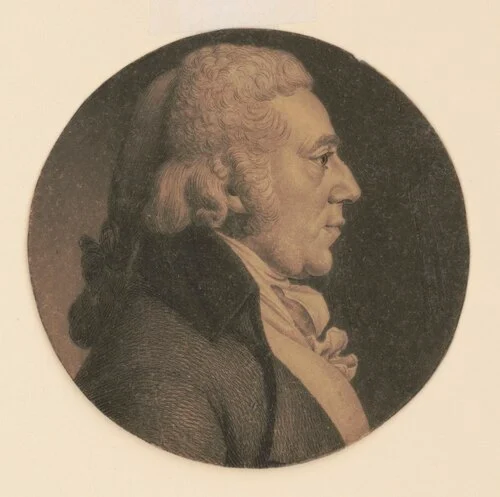
Josiah Quincy III was an American educator and political figure. He was a member of the U.S. House of Representatives (1805–1813), mayor of Boston (1823–1828), and President of Harvard University (1829–1845). The historic Quincy Market in downtown Boston is named in his honor. A panel of 69 scholars in 1993 ranked him among the ten best mayors in American history.
gutenberg.org
He early adopted two principles, as rules of his political conduct, from which he never deviated,--to seek or solicit no public office, and, to whatever station he might be called by his country, to use no instrument for success or…
He considered himself placed between two batteries, neither of which regarded him as one of their soldiers.
Adams surmised that it was owing to the indifference to his success of the leaders of the old Federal party, and remarked on the occasion, "This is among the thousand proofs how large a portion of Federalism is a mere fair-weather…
This error has nowhere been more frequently repeated, nowhere been of more pernicious tendency, than in America itself.
The terms, indeed, in which such a character as Washington has repeatedly expressed himself concerning me, have left me nothing to wish, if they did not alarm me by their very strength.
The rigor of her system already begins to relax, and one year of war to her and peace to us will be more favorable to our interests, and to the final establishment of our principles, than could possibly be effected by twenty years of…
The pride of Britain itself must bend to the course of events.
But circumstances will do more than any negotiation.
Indeed, I have no idea we shall ever obtain, by compact, a better footing for our commerce with this country than that on which it now stands; and therefore the shortness of time, limited for the operation of this part of the compact, is…
As a treaty of commerce it will be indeed of little use to us, and we shall never obtain anything more favorable so long as the principles of the navigation act are obstinately adhered to by Great Britain.
If its operation should turn out more advantageous to them, it will be more honorable for us; and I never can object to entering formally into an obligation to do that which, upon every virtuous principle, ought to be done without it.
I have no doubt our citizens will rally a second time round the standard of Common Sense.
Rather than live otherwise, I would wish to die before my time.
With a tolerable share of common sense, I hope, in America, to be independent and free.
I am determined to get my own living, and to be dependent upon no one.
If there is a Bostonian who ever sailed from his own harbor for distant lands, or returned to it from them, without feelings, at the sight of the Blue Hills, which he is unable to express, his heart is differently constituted from mine.
These have been, through life, perpetual admonitions to do nothing unworthy of it.
Politicians like Josiah Quincy