He knew how little a majority of the men of his own time were disposed or qualified to estimate his character with justice.
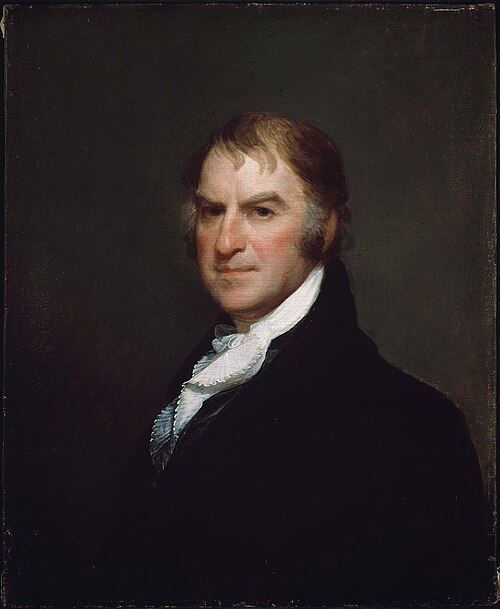
Josiah Quincy
The Public Record
Josiah Quincy III was an American educator and political figure. He was a member of the U.S. House of Representatives (1805–1813), mayor of Boston (1823–1828), and President of Harvard University (1829–1845). The historic Quincy Market in downtown Boston is named in his honor. A panel of 69 scholars in 1993 ranked him among the ten best mayors in American history.
gutenberg.org
Though conscious, being then in his seventy-eighth year, that he stood on the threshold of human life, he sought no relaxation from duty, no exemption from its performance.
Adams replied: "I have no hesitation to say I hold that act unconstitutional and void.
Union!' be this the watchword of your camp; and if Ate, hot from hell, will come and cry 'Havoc!' fight--fight and conquer, under the banner of universal freedom.
May the Ruler of the universe preserve you from such degradation! 'Freedom!
Texas and slavery are interwoven in every banner floating on the Democratic breeze. 'Freedom or death' should be inscribed on ours.
The spirit of freedom and the spirit of slavery are drawing together for the deadly conflict of arms.
They have transmitted that freedom to you; and upon you now devolves the duty of transmitting it unimpaired to your posterity.
The argument for the annexation, or reännexation, of Texas is as gross an imposture as ever was palmed upon the credulity of an honest people.
The charge, therefore, that our government did really give up that important territory, when it was at its option to retain it, is purely and unqualifiedly untrue; and I now charge that it was known by Mr.
In what language of composure or of decency can I say to you that there is in this bitter and venomous charge not one single word of truth; that it is from beginning to end grossly, glaringly, wilfully false?--false even in the name of the…
To such disreputable subterfuges party spirit can condescend, to gratify malignity, or to obscure merit from the knowledge of the world, to the power of which it is itself compelled to yield.
But, with these exceptions, poll the whole mass of Christian men, of every name, sect, or denomination, throughout the globe, and you will not hear a solitary voice deny that slavery is a wrong, a crime, and a curse.
The worshipper of mammon and the philosophical atheist hold no communion with the signers of the declaration that all men are created equal, and endowed by their Creator with unalienable rights.
The owner of a hundred believes it a blessing.
The owner of ten slaves believes that slavery is not an evil.
While our fathers were colonists of England we had no distinctive political or literary character.
His life has been in some respects sui generis; and I venture the opinion that, generally, when his course has differed most from the politicians opposed to him, it has tended most to the advancement of the public good.
Adams has stood between them, uninfluenced by either, contending for the aggrandizement of the nation.
You have recently seen him stand as unmoved as the rock of Gibraltar, defending the right of petition, and the constitutional privileges of the representatives of the people, assembled in Congress, though fiercely assailed by friends and…
The founders of your constitution have left it as their dying commandment to you, to achieve, as the lawful sovereigns of the land, this resplendent glory to yourselves--to patronize and encourage the arts and sciences, and all good…
You have neither Cæsar nor Czar, Caliph, Emperor, nor King, to monopolize this glory by largesses extracted from the fruits of your industry.
The voices of your forefathers, founders of your social compact, calling from their graves, command you to this duty; and I deem it, as your representative, a tacit and standing instruction from you to perform, as far as may be my ability…
What lover of classical learning can read the account in Livy, or in Plutarch, of the restoration to freedom of the Grecian cities by the Roman consul Flaminius, without feeling his bosom heave, and his blood flow cheerily in his veins?
Politicians like Josiah Quincy