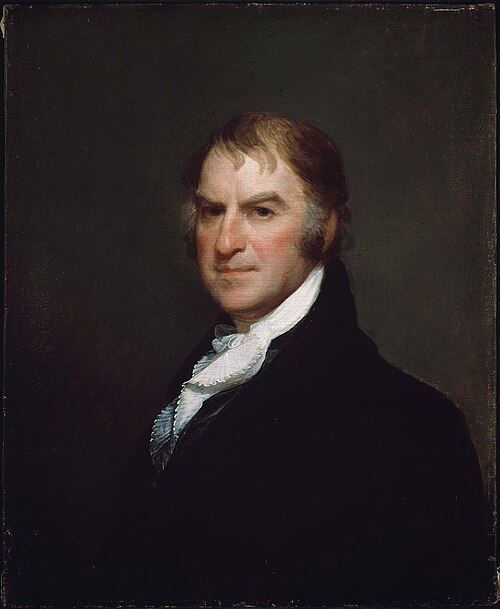
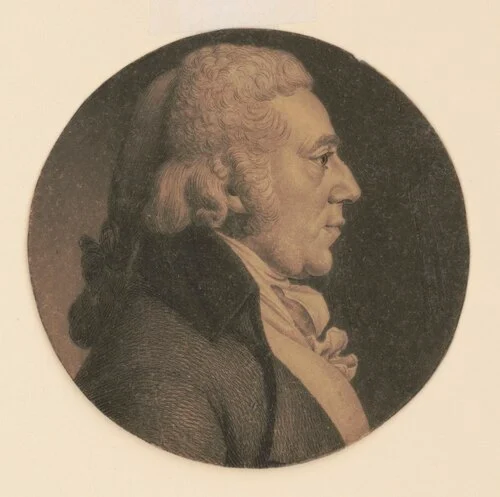
Democracy, pure democracy, has at least its foundation in a generous theory of human rights.
Josiah Quincy
The Public Record
Josiah Quincy III was an American educator and political figure. He was a member of the U.S. House of Representatives (1805–1813), mayor of Boston (1823–1828), and President of Harvard University (1829–1845). The historic Quincy Market in downtown Boston is named in his honor. A panel of 69 scholars in 1993 ranked him among the ten best mayors in American history.
gutenberg.org
That is the native land of nullification, and it is a theory of constitutional law worthy of its origin.
Nullification was generated in the hot-bed of slavery.
But no sooner was John Tyler installed into the President's house than nullification, and Texas, and war with Mexico, rose again upon the surface, with eye steadily fixed upon the polar star of Southern slave-dealing supremacy in the…
Adams, "I exposed the whole system of duplicity and perfidy towards Mexico, which had marked the Jackson administration from its commencement to its close.
Gambling speculation was the madness of the day; and, in the wide-spread ruin which we are now witnessing as the last stage of this moral pestilence, Texan bonds and Texan lands form no small portion of the fragments from the wreck of…
The banks were plunging into desperate debts, preparing for a universal suspension of specie payment, under the shelter of legislative protection to flood the country with irredeemable paper.
Land-jobbing, stock-jobbing, slave-jobbing, rights-of-man-jobbing, were all, hand in hand, sweeping over the land like a hurricane.
The constitutions of the United States and of the Commonwealth of Massachusetts are both the work of the people--one of the Union, the other of the State--not of the whole people by the phantom of universal suffrage, but of the whole…
The name of Democracy was assumed because it was discovered to be very taking among the multitude; yet, after all, it is but the investment of the multitude with absolute power.
When the anti-federal party dropped the name of Republicans to assume that of Democrats, their principles underwent a corresponding metamorphosis; and they are now the most devoted and most obsequious champions of executive power--the very…
The tenth number of the Federalist, written by James Madison, is an elaborate and unanswerable essay upon the vital and radical difference between a democracy and a republic.
The constitution of the United States when adopted was so far from being considered as a democracy, that Patrick Henry charged it, in the Virginia Convention, with an awful squinting towards monarchy.
But the first principles of morals and politics, which have long been settled, acquire the authority of self-evident truths, which, when first discussed, may have been vehemently and portentously contested.
The discourses of John Locke concerning government demolished while they immortalized the work of Filmer, whose name and book are now remembered only to be detested.
No man can be surprised that such a cause was swept away by a moral and political whirlwind; that it carried with it all the institutions of civil society, so that its march was a wild desolation.
It is the only theory upon which slavery can be justified, as conformable to the law of nature.
It cuts the gordian knot with the sword, extinguishes all the rights of man, and makes fear the corner-stone of government.
The talisman of human rights dissolved the spell of political as well as of ecclesiastical power.
The question raised by Martin Luther involved the whole theory of the rights of individual man, paramount to all human authority.
The philosophical examination of the foundations of civil society, of human governments, and of the rights and duties of man, he views as among the consequences of the Protestant Reformation.
Adams controverts, maintaining in opposition to it that the social compact constituting the body-politic is, and by the law of nature must be, a compact not merely of individuals, but of families.
He shows, from the history of Massachusetts, that the fundamental principle asserted in the fifth article of our declaration of rights, that all power resides originally in the people, is derived from the above-named writers, and explains…
But the final decision of this question depends neither upon legislative nor executive, but upon judicial authority; nor can the final decision of the Supreme Court upon it be pronounced before the close of the present Congress.
In this state of things he has assumed, as the committee fully believe, the exercise of the whole legislative power to himself, and is levying millions of money upon the people, without any authority of law.
Politicians like Josiah Quincy